Wendelin's "Christian Theology": Doctrine of Justifying Faith, Part 6

[A fundraising update:
While we give thanks to God for the progress and provision made, we have stalled out at about 30% of the way to our fundraising goal. We could use your help. If you are being blessed by the translation work, please consider supporting the work and speeding it on its way. Click here to watch a brief video on the project.]
THESIS XVIII: The principal adjuncts of faith are four: (1.) Love, which is always conjoined with the study of other good works: (2.) Perseverance, whereby whoever once receives saving faith never loses it, or casts it away: (3.) Certainty, whereby true faith is certain to each believer, so that he knows that he believes, or has faith: (4.) Trial, whereby our faith is often hindered and afflicted.
EXPLANATION: I. That justifying faith is always conjoined with love and the other Christian virtues, we prove:
(1.) Faith without love and the other Christian virtues is dead, that is, does not justify: since it is only a mask of faith.
Therefore, justifying faith is not without love.
The antecedent comes from James, James 2:20.
(2.) He is a liar, that saith that he knoweth God, but keepeth not His commandments, 1 John 2:4.
Therefore, there is no true and saving knowledge of God, which is faith, without love, or observance of the divine commandments.
(3.) By justifying faith we dwell in God, and God in us, 1 John 4:15.
Therefore, love is never separated from justifying faith.
The rationale of the consequence: that, in whom there is no love, God is not in him, as the Apostle says, 1 John 4:16.
(4.) Faith without love doth not profit unto salvation, James 2:14.
Therefore, justifying faith is not without love.
The rationale of the consequence: that justifying faith always profits.
(5.) It is an infallible and abiding mark of those truly believing, that they hear the voice of Christ, and follow Christ, John 10:27.
Therefore, justifying faith is not without love and obedience.
II. The Papists teach, that love and other Christian virtues are able to be separated from justifying faith, and hence justifying faith is sometimes without them, which they prove:
(1.) John 12:42, 43: Many Jews are said to have believed upon Christ, and yet they loved the praise of men more than the praise of God.
Therefore, justifying faith is able to be separated from true love.
Response: I deny the consequence. The rationale: because in John the Jews are said to have believed, not that they embraced Christ with justifying faith, or with respect to trust: but only with respect to general assent. But faith without trust is not justifying.
(2.) Paul says, 1 Corinthians 13:2, Though I have all faith, and have not charity, I am nothing.
Therefore, he indicates that justifying faith is able to be without charity.
Response: I deny the consequence. The rationale: because Paul is not speaking of justifying faith, but of the faith of miracles, as it is evident from the context. And so the particle, all, does not denote the collection of every sort of faith, but only the perfection of the faith of miracles.
(3.) James says, James 2:14, that it doth profit nothing, if a man say he hath faith, but hath not works.
Therefore, he indicates that justifying faith is able to be without good works.
Response: I deny the consequence. The rationale: because James is not speaking of justifying faith, which is present in a sincerely pious man; but of a hypocritical boasting of faith, whereby hypocrites glory in their faith, who nevertheless are not furnished with true and living faith.
(4.) Faith is prior to love.
Therefore, for a time it is without love.
The antecedent is proven: Because faith is the cause of love:
But the cause is prior to the effect.
Response: I deny the consequence. The rationale: because faith is prior to love, not in time, but only by nature. But what is by nature prior to another thing, the same is also able to be at one and the same time. Thus a cause is prior to its effect, by nature, which nevertheless is often at one and the same time with the effect. For example: Fire by nature is prior to warming, as its effect, and yet fire and warming are at one and the same time. Similarly faith by nature is prior to love, but it is at one and the same time with it. At the same time, the Apostle proclaims that love is greater than faith, 1 Corinthians 13:13; for faith shall cease, when it will have come to vision: Love is going to endure forever.
Nevertheless, exceptions are taken:
(1.) If we are justified by faith, and are not justified by love, it follows that faith is greater than love: But the former is true, and so also the latter.
Response: The hypothetical is denied. Because justification is not greater than love and holiness: since holiness and love are the end of justification. Whence no excellence of faith above love is able to be inferred.
Exception is taken: (2.) A cause is more excellent than its effect. But faith is the cause of love: Therefore, it is more excellent than love.
Response: The major is not universally true of every cause: there are instrumental causes, which are not equal in excellence to their effects: thus medicine is not more excellent than health: a hammer is not more excellent than a golden vessel.
III. That true and justifying faith is never totally lost or cast away, is the opinion of the Orthodox, which is proven by the following arguments:
(1.) Because believers are after the likeness of trees that are planted by the rivers of water, that always bring forth fruit and never wither, Psalm 1:3.
(2.) Because in the souls of believers God has instilled a reverence for Himself, that they withdraw not from Him, Jeremiah 32:40.
(3.) Because Jehovah holds their hands, lest they be cast down, Psalm 37:23, 24.
(4.) Because Christ prays for them, that their faith would never fail, John 17:15, 20.
(5.) Because no one is able to snatch the sheep of Christ, that is, true believers, out of His hand, John 10:28, 29.
(6.) Because those that believe upon Christ have in themselves that bread which endures unto eternal life, John 6:27.
(7.) Because those that eat of the bread that Christ gives, that is, those that believe upon Christ, live forever, John 6:50, 51.
(8.) Because they have in themselves a fountain of watering springing up into everlasting life, John 4:14.
(9.) Because believers sin not, nor are able to sin unto death, because the seed of God abides in them, 1 John 3:9.
(10.) Because nothing is able to separate believers from the love of God, Romans 8:38, 39. See Exercitation 124.
IV. The Papists and the Lutherans defend the contrary opinion: namely, that justifying faith is sometimes lost: or, that true believers are often turned into unbelievers, with faith cast away; which they prove:
(1.) Christ says, Luke 8:13, that some believe for a while, and fall away in a time of temptation.
Therefore, He signifies that some fall away from justifying faith.
Response: I deny the consequence. The rationale: Because Christ is not speaking of justifying faith, or trust embracing the merit of Christ; but of general assent only, or an external profession of faith.
(2.) Paul says, Galatians 5:4, that those that want to be justified by the law are fallen from grace.
Therefore, he indicates that some fall from justifying faith.
Response: I deny the consequence. The rationale: Because Paul does not simply say, that some fall from grace, but with a condition: If they wish to be justified by the law. But a conditional proposition affirms nothing unless the condition be posited and granted.
Then, to fall from grace here, to Paul, is not to fall from justifying faith, but to repudiate the doctrine of grace or the Gospel.
(3.) Some concerning faith have made shipwreck, 1 Timothy 1:19.
Therefore, they fall from justifying faith.
Response: I deny the consequence. The rationale of the denial: because the Apostle is not speaking of justifying faith, but merely of assent and profession of Evangelical doctrine.
(4.) Some depart from the way of righteousness, which they have known, and go back from the holy doctrine delivered to them, 2 Peter 2:21.
Therefore, they fall from justifying faith.
Response: I deny the consequence. The rationale: Because it is one thing to fall from justifying faith, but another to depart and go back from the way of righteousness, that is, Evangelical doctrine, to which assent alone is given without trust.
(5.) Paul warns those that stand by faith to take heed to themselves lest they fall.
Therefore, he indicates that some sometimes fall from justifying faith.
The antecedent is proven, 1 Corinthians 10:12; Romans 11:20.
Response: I deny the consequence. The rationale of the denial: Because Paul does not teach that some fall from justifying faith, but shows the manner in which they can and ought to beware of defections: namely, if they abstain from carnal security. But the Holy Spirit’s warnings of this sort are efficacious means, whereby He keeps believers in their duty, and preserves them from defection.
(6.) Our first parents fell from God.
Therefore, true believers are also able to fall from God, and sometimes do fall.
Response: I deny the consequence. The rationale: because to our first parents in the state of innocency was given grace, whereby they were able to persevere in their integrity, if they will: but grace was not given, whereby they would will to persevere [if they had been able]. But after the fall to those justified and furnished with true faith is given grace, whereby they are not only able, but also willing to persevere, Philippians 2:13.
(7.) David fell from faith and righteousness, when he became an adulterer and murderer: Solomon also fell, when he practiced idolatry: finally, Peter also fell, when he denied Christ.
Therefore, some do fall from justifying faith.
I deny the antecedent: For, even if it is beyond controversy that the sins of David, Solomon, and Peter were most grievous; yet they did not consequently lose faith completely, but for a time they buried it, like fire under ashes.
But why do we believe that they did not lose faith completely? these, among others, are our reasons:
1. Because they did not sin with full consent of their will, but from the weakness of the flesh.
2. Because they earnestly repented: which is an indication and fruit of faith. Concerning the repentance of David and Peter we have express testimonies of Scripture.[1] Neither are our Theologians left in doubt concerning Solomon: the opinion of most is that Ecclesiastes was written by him as a sign of repentance. On behalf of Peter’s faith, that it might not fail, Christ’s intercession is express, Luke 22:32, I have prayed for thee, that thy faith fail not. See Exercitation 121.
V. The Papists also fight against the certainty of faith, when they deny that individual believers know, or are able to know, that they are furnished with the habit of true faith. That we truly believing know this, we prove with the following arguments:
(1.) Because they know themselves to be in Christ, and Christ in them, John 14:20. But Christ is in believers by faith. Therefore, it is right for them to be certain of their faith, if they are certain of the indwelling of Christ.
(2.) Because they are able to know themselves, to try and to prove themselves, whether they be in the faith, 2 Corinthians 13:5.
(3.) Because they, when earnestly questioned, are able to confess it, and do confess to the Lord Himself; and that conscientiously, Matthew 9:28; Mark 9:24.
(4.) Because the spirit of a man knows what things are in the man, 1 Corinthians 2:11.
(5.) Because by the Spirit of God we know what things He has freely give to us, 1 Corinthians 2:12.
(6.) Because we are able distinctly to perceive proper acts of faith, as when one out of sincere and pious affection knows that he is prepared to deny all carnal reasoning and himself entirely, so that he might be able to serve and cleave to God according to His will.
VI. On behalf of uncertainty the Papists thus object:
What is able to be certain with the certainty of faith, either is expressly contained in the word of God, or is able thence to be deduced by legitimate consequence.
But that this one or that one, I or you, truly believes, is not expressly contained in the word of God, neither is it able thence to be deduced by legitimate consequence.
Therefore, that this one or that one, I or you, truly believes, is not able to be certain with the certainty of faith.
Response: The conclusion does not contradict us: For we do not specifically say, that with the certainty of faith we are able to be certain that we are truly believing; but indefinitely, that we are able to be certain.
With what certainty then, you will ask? Response: With the certainty of internal vision or of the testimony of our mind illuminated by the Holy Spirit, who bears witness to our spirit, that we are the sons of God,[2] and so are truly believing.
Therefore, this certainty is not written in the book of Scripture, but in the book of our heart, even indeed with the finger of the Holy Spirit. Hence we do not believe that we believe, but rather we see or sense: just as we do not believe that we think about God, but we know and experience it in our mind. See Exercitation 122.
VII. Our faith is liable to various trials, against which it is to be properly fortified, so that we might be kept from the precipice of desperation.
Now, our faith is tried, 1. when we do not sense its fruits, against which trial we maintain ourselves: (1.) If we consider, that the want of many fruits is able to argue a languid and weak faith, but not necessarily no faith, 2 Peter 1:8. (2.) If with the whole heart we choose Christ as savior: which is sufficient for the being of faith, while what things pertain to the well being of faith are being added, Colossians 2:7. (3.) If we call to mind our former sense of it, although it does not appear in the present, Psalm 77:5, 6, 11, and also consult the judgments of other pious men concerning us, Hebrews 6:9; 2 Corinthians 2:7, 8.
It is tried, 2. When we feel signs of the anger of God, at which time a threefold consideration ought to sustain us, (1.) that many signs of the anger of God are able at the same time to be consistent with His favor, Psalm 99:8. (2.) That Christ Himself tasted the wrath of God, Matthew 27:46. (3.) That believers ought under hope to believe against hope, Romans 4:18, and by faith to wrestle with God, Genesis 32:24; Hosea 12:4, 5.
It is tried, 3. When we sense (not) its many degrees of growth, at which time it is to be considered, (1.) that sometimes there are hidden degrees of growth, which are not so able to be perceived. (2.) That growth in faith is not in all moments, Hebrews 5:12. Trials, which at present hinder the increase of faith, are able to advance the same into the future.
It is tried, 4. When we fall into sins of a more grievous sort: at which time it is to be considered, (1.) That from the weakness of faith we have fallen into them, and so faith is not to be cast aside, but strengthened, Ephesians 6:16; 1 Peter 5:9; Luke 22:32. (2.) That the duty of believers is, not to flee from God because of sins, but to flee from sins because of God, and to cleave to Him in Christ, John 3:14 [with Numbers 21:9].
It is tried, 5. When afflictions come wave upon wave: at this point it is to be considered, (1.) that trials of this sort are the fruits of God, Hebrews 12:6. (2.) That there will be a turning unto the good, Romans 8:28. (3.) That the grace of God must be sufficient in all things, 2 Corinthians 12:9.
VIII. An external profession of faith is necessary. (1.) Because God commands it, 1 Peter 3:15. (2.) Because it has the promise of salvation, Matthew 10:32; Romans 10:10. (3.) Because the neglect of confession and external profession has the greatest condemnation conjoined, Mark 8:38; Luke 9:26; 18:8; 2 Timothy 2:12. (4.) Because this profession is for the edification of others, and its neglect is scandalous, Philippians 1:12; 2:15, 16. (5.) Because it makes for the glory of God, Philippians 1:20, the refusal of which is a great insult to God, Luke 9:26. Therefore, faith is never and nowhere to be denied: although it is not necessary to profess it everywhere and without discrimination. But finally, when there is a hope that the profession is going to result in the glory of God and the edification of the neighbor: since the necessity of the means is to be estimated according to the relation that it has to the end. But if you are asked publicly concerning your faith by one that is settled in authority and whom you are obliged to honor, confession absolutely must be made: because then it pertains to the glory of God, and your salvation, and that of others, Matthew 10:18. Neither, in order to decline danger, is it lawful to make use of ceremonies, of which particular use is made by those that are strangers to our faith: because this is hypocrisy, and the end of ceremonies is profession.
It is asked at this point: Whether one might be able to attend condemned worship with a sound conscience, if he keeps his mind averse to it?
Response: He is not able, if without urgent necessity he be present, with no external profession of his faith, and no disapproval of the condemned worship, preceding: especially if he conducts himself in the same manner in which those that profess that idolatrous worship and impious religion are wont. Rationale: because this is damnable hypocrisy, whereby he sins against himself; against his neighbor, 1 Corinthians 8:10; against God, 1 Corinthians 10:20-22.
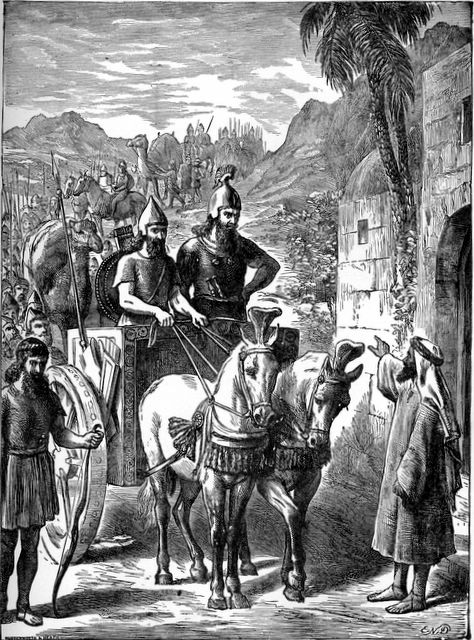
At this point the example of Naaman is objected, out of 2 Kings 5:18, where Naaman, embracing the Jewish religion, in the presence of Elisha the Prophet asks, that God would forgive these things, if with his King, going to perform a sacred rite, and going to invoke Rimmon, he enter an idolatrous shrine, and bow down with his king. The Prophet responds: verse 19, Go in peace. What is sought of us, and what we ourselves answer to be illicit, appears to be permitted to Naaman here.
Response: This passage and example vexes and exercises interpreters. The question is: Whether he entreats and asks to be forgiven what he did before his converstion: or what he was going to do after conversion? Some more recent interpreters embrace the former: all others in great numbers, the latter. Yet no one affirms to be permitted what we answer to be illicit.
The words of Naaman are taken concerning the future by the Chaldean,[3] Greeks,[4] Jerome, Pagnine,[5] Luther, Vatablus,[6] Munster,[7] Junius[8] and Tremellius,[9] the French, Italian, and Spanish: Yet in such a way that a great many deny that what Naaman sought was conceded by the Prophet. The words of the Prophet: Go in peace:[10] thus Junius παραφράζει/paraphrases: Be of a quiet mind, and worry not over these matters, which make not for the peace of thy conscience; but rather are going to agitate it, and provoke God against thee. The same expression is found in 1 Samuel 1:17;[11] 2 Kings 4:23,[12] 26.[13] So also the French, Italian, and Spanish. Some more recent men, likewise skilled in Hebraic letters, found their past tense upon grammatical reasons: Among which are also these, that the gerund or infinitive, which sort is בְּבוֹא, when he goeth into, in this passage, with a preterite preceding or following, ought also to be understood with the signification of the preterite: but in this passage the preterite הִשְׁתַּחֲוֵיתִי, I bowed myself, follows:[14] To those taking exception, that the signification is of the future, because of the waw conversive, he answers that the ו/waw is not conversive, because the accent is not transferred to the ultima, but copulative: And in this way every scruple is readily loosed, if the proof of the preterite be evident.
But, since, (1.) all those most skillful in Hebraic literature and the most learned Theologians, with the accent not withstanding, acknowledge the future here: (2.) the dispute is yet undecided, whether the accents are of divine authority and were written with the prophetic hand: (3.) in the sacred books verbs are ready to hand (which these very authors do not deny), which signify the future, even without the transfer of the accent: (4.) the future implies nothing absurd, does not tie a knot difficult to loose: (5.) with all things honestly considered, by the words in verse 18, Naaman appears to ask, not a past thing, but a future thing, to be forgiven him: seeing that he had already acknowledged his past idolatry, verse 15, and doubtlessly was begging pardon. But, since he had no disposition to desert his king or his office, a scruple immediately arose, not whether he could again worship Rimmon (for he protests that he is not going to do so, verses 15, 17), or he could simulate idolatrous worship, by an external gesture, although his intention was otherwise (for this suspicion does not fall upon a prudent and religious man; especially since he also publicly determined to sacrifice to the God of Israel, and to this end, for the construction of an altar, he asked holy earth from the prophet, verse 17): but whether he could render civil service to his King again in the shrine of Rimmon with his conscience preserved, in bowing himself, not for the sake of Rimmon, but of the King.
Moved by these reasons, we embrace, in keeping with the judgment of the learned, not the past tense, but the future, with all ancient interpreters, and also a great many of the more recent, although the paraphrase, of which mention has already been made, is able to appear not so necessary and evident. For it supposes that Naaman begged pardon for hypocrisy: which does not appear likely to us, on account of the reason that we just now alleged: to which we also add this: but if Naaman had begged pardon for ὑποκρίσεως/hypocrisy, the prophet would have contradicted him far more plainly, and would not have dismissed him with the ambiguous response, Go in peace. Therefore, the prophet understood the scruple only concerning rendering civil service to the King in the Temple of Rimmon, rising in Naaman’s mind, which is also the opinion of Lyra:[15] who also denies that the Prophet dispensed here: but declared that to be lawful, which Naaman was thinking to be unlawful. Naaman was having, says Lyra, the office of supporting the King, just as queens are now supported by their soldiers: so similarly kings by princes more closely related to them: but that was not unlawful by nature: for it was equally able to be done outside the temple of the idol, as also inside. In that place he adduces a similar example of a Christian girl taken captive by the Saracens: she, having been assigned to the service of a certain mistress in order to carry the train of her garment, may lawfully carry it both within and without the sanctuary of Muhammad, if she intend only to fulfill her duty to her Mistress, not to exhibit reverence for Muhammad. He affirms that only pardon for fulfilling his civil office to the King was entreated by Naaman, and what he asked, he obtained from the Prophet. So likewise Theologians formerly answered that Evangelical Princes were able to attend upon the Emperor frequenting the mass in his chapel, as Sleidanus testifies.[16] This opinion of Lyra is discussed at length and defended by Cajetan. The same Lyra also thinks that the earth sought for constructing an altar was granted, because Naaman, as foreigner, was not bound to the ceremonial worship of Moses; since he was not circumcised: just as before the law sacrifices were offered in various places by uncircumcised pious men. But, whatever the case may be, there is no evident reason to prefer the past tense over the future.
* IX. It is asked: Whether, in addition to saving faith, there is any other saving faith, which is not directed toward Christ?
Response: That no such faith is granted, is proven.
(1.) Because Scripture nowhere raises any hope of salvation outside of Christ, John 3:18, 36; Acts 4:12.
(2.) Because the Apostle expressly denies that the Gentiles of old were saved through their natural knowledge of God, Romans 1:21-23.
(3.) Because the Gentiles of old, even with the natural knowledge of God, were strangers from the covenants of promise, having no hope, and without God in the world, Ephesians 2:12.
(4.) Because the Gentiles of old, placed outside of Christ, died in their trespasses and sins, Ephesians 2:1, and were by nature children of wrath, verse 3.
(5.) Because in all unbelieving Gentiles was mind of the flesh, which is enmity against God, Romans 8:7.
(6.) Because by the unwritten law, which sort was in the Gentiles, no one is justified and saved, Galatians 3:11.
(7.) Because the Gentiles, placed outside of Christ were all under sin; there is none righteous, no, not one; there is none that understandeth, there is none that seeketh after God; there is none that doeth good, Romans 3:10-13. Who then would say that by natural knowledge it is possible to be saved outside of Christ?
(8.) Because the Gentiles outside of Christ were all natural/animal. But the natural/animal man receiveth not the things of the Spirit of God, neither can he know them, because they are spiritually discerned, 1 Corinthians 2:14.
[1] See 2 Samuel 12:13; Psalm 51; Matthew 26:75; Mark 14:72; Luke 22:61, 62.
[2] Romans 8:16.
[3] The Targumim are ancient Chaldean/Aramaic translations and interpretive paraphrases of the Hebrew Bible, with roots in the intertestamental period.
[4] The Septuagint.
[5] Pagnine (1466-1541) was an Italian Dominican. He was gifted as a Hebraist, exegete, and preacher. He was commissioned by Pope Leo X to produce a new Latin translation of the Scripture.
[6] Francis Vatablus (c. 1485-1547) was a prominent Hebrew scholar, doing much to stimulate Hebraic studies in France. He was appointed to the chair of Hebrew in Paris (1531). Because of some consonance with Lutheran doctrine, his annotations (Annotationes in Vetus et Novum Testamentum), compiled by his auditors, were regarded with the utmost esteem among Protestants, but with a measure of suspicion and concern by Roman Catholics. Consequently, the theologians of Salamanca produced their own edition of Vatablus’ annotations for their revision of the Latin Bible (1584).
[7] Sebastian Munster (1489-1552) was a German scholar of great talent in the fields of mathematics, Oriental studies, and divinity. He left the Franciscans to join the Lutherans, became Professor of Hebrew at Basil (1529-1552), and produced an edition of the Hebrew Bible with a Latin translation and important early Reformation annotations (Annotationibus in Vetus Testamentum).
[8] Francis Junius (1545-1602) was a Huguenot divine of great learning. He suffered the varied fortunes of his people; but he had the opportunity to study in Geneva, and he was eventually appointed Professor of Divinity at Leiden (1592). Junius’ De Vera Theologia was massively important in the development of the Dogmatic structure of Reformed Scholasticism. He also labored with Tremellius in the production of their famous Latin Version of the Old Testament.
[9] John Immanuel Tremellius (1510-1580) converted from Judaism to Christianity and quickly embraced the principles of the Reformation. He taught Hebrew at Strasburg (1541) and at Cambridge (succeeding Paul Fagius in 1549), and served as Professor of Old Testament at Heidelberg (1561).
[10] 2 Kings 5:19: “And he said unto him, Go in peace (לֵ֣ךְ לְשָׁל֑וֹם). So he departed from him a little way.”
[11] 1 Samuel 1:17: “Then Eli answered and said, Go in peace (לְכִ֣י לְשָׁל֑וֹם): and the God of Israel grant thee thy petition that thou hast asked of him.”
[12] 2 Kings 4:23: “And he said, Wherefore wilt thou go to him to day? it is neither new moon, nor sabbath. And she said, Peace (שָׁלוֹם).”
[13] 2 Kings 4:26: “Run now, I pray thee, to meet her, and say unto her, Is it peace with thee (הֲשָׁל֥וֹם לָ֛ךְ)? is it peace with thy husband (הֲשָׁל֥וֹם לְאִישֵׁ֖ךְ)? is it peace with the child (הֲשָׁל֣וֹם לַיָּ֑לֶד)? And she answered, Peace (שָׁלוֹם).”
[14] 2 Kings 5:18: “In this thing the Lord pardon thy servant, that when my master goeth into (בְּב֣וֹא אֲדֹנִ֣י) the house of Rimmon to worship there, and he leaneth on my hand, and I bow myself in the house of Rimmon (וְהִֽשְׁתַּחֲוֵ֙יתִי֙ בֵּ֣ית רִמֹּ֔ן): when I bow down myself in the house of Rimmon, the Lord pardon thy servant in this thing.”
[15] Little is known about the early life of Nicholas de Lyra (1270-1340). He entered the Franciscan Order and became a teacher of some repute in Paris. His Postilla in Vetus et Novum Testamentum are remarkable for the time period: Lyra was firmly committed to the literal sense of the text, as a necessary control for allegorical exposition; and he drew heavily upon Hebraic and Rabbinical materials. His commentary was influential among the Reformers.
[16] Johannes Sleidanus (1506-1556) was a German Lutheran scholar and diplomat. He is remembered as the first major historian of the Reformation. Sleidanus’ principal work was the Commentarii de statu religionis et reipublicæ Carolo V Cæsare.


WCF 11:2: Faith, thus receiving and resting on Christ and His righteousness, is the alone instrument of justification;1 yet is it not alone in the person justified, but is ever accompanied with all other saving graces, and is no dead faith, but worketh by love.2
1 John 1:12; Rom. 3:28; Rom. 5:1.
2 James 2:17,22,26; Gal. 5:6.
WCF 14:3: This faith is different in degrees, weak or strong;1 may be often and many ways assailed and weakened, but gets the victory;2 growing up in many to the attainment of a full assurance through Christ,3 who is both the author and finisher of our faith.4
1 Heb. 5:13,14; Rom. 4:19,20; Matt. 6:30; Matt. 8:10.
2 Luke 22:31,32; Eph. 6:16; 1 John 5:4,5.
3 Heb. 6:11,12; Heb. 10:22; Col. 2:2.
4 Heb. 12:2
Follow the translation of Wendelin's Christian Theology:
www.fromreformationtoreformation.com/introductory-theology
Volume 1 of Wendelin's Christian Theology is now available in print!
https://www.lulu.com/shop/steven-dilday/wendelins-christian-theology-volume-1/hardcover/product-yv54k5p.html?q=wendelin&page=1&pageSize=4