Poole on 1 Kings 5:13-18: Solomon's Levy

Verse 13:[1] And king Solomon raised a levy (Heb. tribute of men[2]) out of all Israel; and the levy was thirty thousand men.
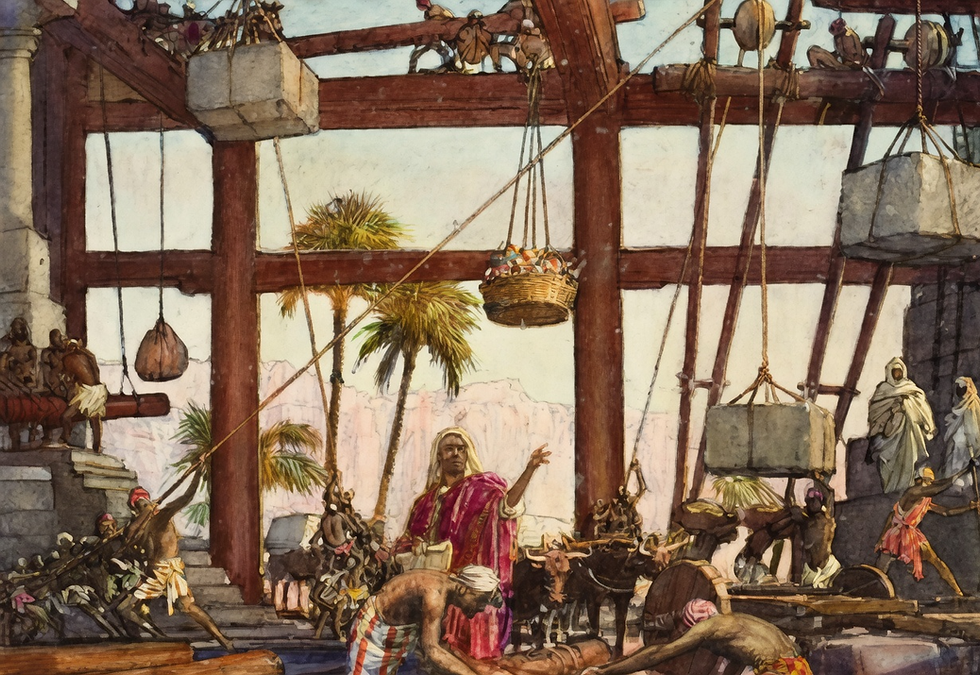
[And King Solomon chose laborers,וַיַּ֙עַל הַמֶּ֧לֶךְ שְׁלֹמֹ֛ה מַ֖ס ] Verbatim: And he caused to ascend a tribute (Montanus, Vatablus, Piscator). He levied (or exacted [Syriac], imposed [Mariana, Junius]) a tribute (Pagnine), that is, personal, or consisting of persons, as it is perceived from what follows (Piscator). He levied (or, raised [Piscator]) a levy (Junius and Tremellius); he extracted a sum (Munster, Tigurinus).
[And the levy was, etc.] Hebrew: the tribute,[3] that is, that thirty thousand men of Israel might be given to him (Vatablus). These are believed to have been of the sons of Israel; who alone were cutting down the trees with the servants of Hiram, and were drawing them to the sea with teams of horses (Munster). These were the prefects of the works, who would see to it that the work ceased not, as it is evident from 1 Kings 9:22 (Tirinus). But the rest, who performed more grievous labors, were proselytes. Moreover, certain interpreters expound מַס here as tribute of money, which was given for the hire of the thirty thousand men; but this is confuted by Kimchi out of what follows, he sent them to Lebanon, etc. (Munster). [Jonathan thus translates the passage: And he appointed thirty thousand men as collectors of the tributes.]
The levy: Which were to be employed in the most honourable and easy parts of the work relating to the temple, in the manner expressed, verse 14. And these were Israelites; but those one hundred and fifty thousand, mentioned verse 15, were strangers, by comparing this with 1 Kings 9:21, 22. If it seem strange to any man that so many thousands should be employed about so small a building as the temple was, it must be considered, 1. That the temple, all its parts being considered, was far larger than men imagine, of which more hereafter. 2. That it is probable, that they were employed by turns, as the thirty thousand were, 1 Kings 5:14, else they had been oppressed with hard and uninterrupted labours. 3. That the timber and stone hewed and carried by them was designed, not only (though principally) for the temple, but also for Solomon’s own houses and buildings; because we read of no other levy of men, nor of any great care and pains taken, after the building of the temple, for the procurement or preparation of materials for his own houses, or his other buildings; which implies, that that work was done before; nay, that this very levy of men was made and employed for the building of the Lord’s house, and Solomon’s house, and Millo, and the wall of Jerusalem, and Hazor and Megiddo, and Gezer, is expressed 1 Kings 9:15, which may fully satisfy that scruple.
Verse 14:[4] And he sent them to Lebanon, ten thousand a month by courses: a month they were in Lebanon, and two months at home: and (1 Kings 4:6) Adoniram was over the levy.
[By individual months alternately, בַּחֹ֙דֶשׁ֙ חֲלִיפ֔וֹת] In a month, by turns (Montanus), or alternately (Jonathan); by month (or in individual months [Syriac, thus Pagnine], or for a month [Junius and Tremellius]) alternately (Tigurinus, Syriac), by turns (Junius and Tremellius, similarly Munster). Hebrew: by changes[5] (Junius, Piscator). Others: by exchanges, because each month they were exchanged and renewed (Vatablus). Thus Solomon exercised humanity; and he was unwilling to weary or oppress them (Martyr).
[Over the levy] That is, he was put in charge of this tribute; that is, all these (Vatablus).
Verse 15:[6] (1 Kings 9:21; 2 Chron. 2:17, 18) And Solomon had threescore and ten thousand that bare burdens, and fourscore thousand hewers in the mountains…
[Who were bearing burdens] Among these understand drivers and sailors, and other skilled men of this sort, who were especially necessary for such and so many works (Menochius, similarly Lapide). Bearers of burdens, who would bring stones from the quarrymen to the place to which carts could approach (Vatablus).
[Hewers of stone, חֹצֵ֥ב בָּהָֽר׃] Those cutting (that is, stones [Vatablus]) in the mountain (Pagnine, Vatablus). Under hewers of stone, that is, quarrymen, understand the hewers of timber; but the quarrymen alone are mentioned, because these were more than the woodcutters (Lapide). Those cutting, hewers, in the mountain, namely, Libanus,[7] which is called the mountain by way of eminency. That hewers is ambiguous, whether of stones or timbers. We will understand both without any absurdity. חָצַב is wont ordinarily and properly to be used of the quarrying of stones; although in Isaiah 10:15 it appears to be used of the cutting of timbers[8] (Malvenda). Whether this mountain was Libanus, is not evident. Some conjecture that they were diverse mountains (Martyr).
Hewers: Either of timber, or rather of stones; for Hiram had taken care of the timber.
Verse 16:[9] Beside the chief of Solomon’s officers which were over the work, three thousand and three hundred, which ruled over the people that wrought in the work.

[Besides the overseers, לְ֠בַד מִשָּׂרֵ֙י הַנִּצָּבִ֤ים] Only from the chief men attending (Montanus); besides the chief men and prefects (Pagnine), or who were placed in charge, that is, whom Solomon had set over the work (Vatablus).
[Three thousand and three hundred] But in 2 Chronicles 2:18 three thousand and six hundred are numbered. How do these numbers agree? Response 1: Of those six hundred there were three hundred that were set over the overseers or prefects (Menochius out of Sà and Cajetan and Dionysius and Lapide out of Vatablus and Salian, Hebrew in Vatablus on Chronicles, similarly Grotius, Martyr). Three hundred were set immediately over the workmen; over these prefects another three hundred prefects were set (certain interpreters in Malvenda). Response 2: Three hundred were ordinary; three hundred others were superadded, who in the case of necessity might supply their place, with some retiring; so that the three thousand and three hundred might always be complete (Buxtorf’s Vindication 406). Besides those three thousand strangers, concerning whom 2 Chronicles 2:2, 18, whom those Israelite overseers, concerning whom 1 Kings 5:13-15, had put in charge of one hundred and fifty thousand workmen: so that each of the three thousand was placed over fifty workmen: but the six hundred remaining were by turns exacting an account from these three thousand, each from ten of them. Therefore, in this place there are only three thousand and three hundred, but in Chronicles three thousand and six hundred, with three hundred added, who were furnishing vicarious works (Junius). Response 3: Those additional three hundred in Chronicles were more highly skilled artisans and workmen, concerning whom it is said, and they hewed…and the Giblites, etc.[10] (Abarbanel in Buxtorf). Response 4: Three hundred were prefects of the burden-bearers and quarrymen; three hundred were put in charge of the works in the mount Libanus (certain interpreters in Martyr).
[Who were in charge, הָרֹדִים] Who were ruling, that is, who were rousing the men to work (Vatablus).
Three thousand and three hundred: Whereof three thousand were set over the one hundred and fifty thousand, expressed verse 15, each of these over fifty of them, and the odd three hundred were set over these three thousand, each of these to have the oversight of ten of them, to take an account of the work from them. But in 2 Chronicles 2:18, these overseers are said to be three thousand and six hundred. Answer: The three hundred added in 2 Chronicles 2 might be a reserve, to supply the places of the other three thousand; yea, or of the three thousand and three hundred; as any of them should be taken off from the work by death, or sickness, or weakness, or necessary occasions; which was a prudent provision, and not unusual in such-like cases. And so there were three thousand and six hundred commissioned for the work, but only three thousand and three hundred employed at one time; and therefore both computations may fairly stand together. Some learned men add, that those three thousand and six hundred were strangers, which indeed is manifest from 2 Chronicles 2:17; and that those three thousand and three hundred were a distinct number of men, and Israelites, which were set over all the rest, both strangers and Israelites; who therefore are here called the chief of Solomon’s officers, and are said to rule over the workmen; whereas all that is said of those three thousand and six hundred, 2 Chronicles 2:18, is, that they were overseers to set the people a work; which may deserve further consideration. Others say, that the three hundred added in 2 Chronicles were overseers of the Tyrian workmen in Mount Lebanon, and the rest in all other places; or that they were set over some particular and more curious and considerable parts of the work.
Verse 17:[11] And the king commanded, and they brought great stones, costly stones, and (1 Chron. 22:2) hewed stones, to lay the foundation of the house.
[That they lead out, וַיַּסִּעוּ [12]] Verbatim: and they cause to set out (Vatablus); that they convey (Pagnine).
[Precious stones] Not gems: but they were excellent in a general way in their form and size (Junius, Piscator), the best (Menochius), or of the greatest value (Vatablus, Menochius), which sort are used in splendid edifices (Tirinus), marble (Lapide).
Costly stones; marble and porphyry, or other stones of great size and value. To lay the foundation of the house; where they could not afterward be seen; and therefore that this was done, is mentioned only as a point of magnificence, except it was intended for a type or mystical signification of the preciousness of Christ, who is the foundation of the true temple, the church of God, as he is called, Isaiah 28:16; 1 Corinthians 3:11.
[And square them, אַבְנֵ֥י גָזִֽית׃ [13]] Stones hewed (Pagnine), polished (Vatablus). These either are set on top of the foundation (thus Vatablus), or are placed in the foundations, where rough stone are wont to be placed. This pertains then to magnificence, rather than to necessity (Martyr).
Verse 18:[14] And Solomon’s builders and Hiram’s builders did hew them, and the stonesquarers (or, Giblites:[15] as Ezek. 27:9): so they prepared timber and stones to build the house.
[The Giblites, וְהַגִּבְלִים [16]] And the Giblim (Pagnine, Vatablus, Montanus, Tigurinus, Strigelius), Phœnicians that were possessing Gebal. Pliny, Natural History 5:20, mentions the promontory of Gebal (Grotius). Certain interpreters: and the citizens of Gebal, who were the most highly skilled stonemasons (Vatablus, similarly Tirinus out of Sanchez, Martyr). Concerning this Gebal, see Psalm 83:7 (Tirinus). Of this Ezekiel also makes mention. The Heathen called it Byblos (Martyr). The Giblites, or Byblites (for b and g are constantly being exchanged), are said to be from Byblos, a city of Phœnicia, as Adrichomius[17] testifies, Theater of the Holy Land 185:11, in which were the temples of Adonis, Strabo’s Geography 16; today it is called Gaeta (Lapide). [Others render it appellatively:] hewers (Jonathan), and workmen (Castalio), quarrymen (Syriac), who were in charge of hewing stones (Arabic). These workmen are called גִּבְלִים, because by hewing stones they were forming them in an elegant figure (certain interpreters in Lapide); or because they were finishing them with certain boundaries (certain interpreters in Munster), because with singular industry they were fitting the sculpted stones to their walls and angles (Munster).
The stonesquarers; Hebrew, the Giblites; the inhabitants of Gebal, a place near Zidon, named Psalm 83:7; Ezekiel 27:9, famous for artificers and architects, Joshua 13:5. These are here mentioned apart, as distinct from the rest of Hiram’s builders, as the most eminent of them.
[1] Hebrew: וַיַּ֙עַל הַמֶּ֧לֶךְ שְׁלֹמֹ֛ה מַ֖ס מִכָּל־יִשְׂרָאֵ֑ל וַיְהִ֣י הַמַּ֔ס שְׁלֹשִׁ֥ים אֶ֖לֶף אִֽישׁ׃
[2] Hebrew: מַס.
[3] Hebrew: הַמַּס.
[4] Hebrew: וַיִּשְׁלָחֵ֣ם לְבָנ֗וֹנָה עֲשֶׂ֙רֶת אֲלָפִ֤ים בַּחֹ֙דֶשׁ֙ חֲלִיפ֔וֹת חֹ֚דֶשׁ יִהְי֣וּ בַלְּבָנ֔וֹן שְׁנַ֥יִם חֳדָשִׁ֖ים בְּבֵית֑וֹ וַאֲדֹנִירָ֖ם עַל־הַמַּֽס׃ ס
[5] חָלַף signifies to pass on or away; חֵלֶף, exchange; חֲלִיפָה, a change.
[6] Hebrew: וַיְהִ֧י לִשְׁלֹמֹ֛ה שִׁבְעִ֥ים אֶ֖לֶף נֹשֵׂ֣א סַבָּ֑ל וּשְׁמֹנִ֥ים אֶ֖לֶף חֹצֵ֥ב בָּהָֽר׃
[7] In Lebanon.
[8] Isaiah 10:15: “Shall the axe boast itself against him that heweth (הַחֹצֵב) therewith? or shall the saw magnify itself against him that shaketh it? as if the rod should shake itself against them that lift it up, or as if the staff should lift up itself, as if it were no wood.”
[9] Hebrew: לְ֠בַד מִשָּׂרֵ֙י הַנִּצָּבִ֤ים לִשְׁלֹמֹה֙ אֲשֶׁ֣ר עַל־הַמְּלָאכָ֔ה שְׁלֹ֥שֶׁת אֲלָפִ֖ים וּשְׁלֹ֣שׁ מֵא֑וֹת הָרֹדִ֣ים בָּעָ֔ם הָעֹשִׂ֖ים בַּמְּלָאכָֽה׃
[10] 1 Kings 5:18: “And Solomon’s builders and Hiram’s builders did hew them, and the stonesquarers (וְהַגִּבְלִים, and the Giblites): so they prepared timber and stones to build the house.”
[11] Hebrew: וַיְצַ֣ו הַמֶּ֡לֶךְ וַיַּסִּעוּ֩ אֲבָנִ֙ים גְּדֹל֜וֹת אֲבָנִ֧ים יְקָר֛וֹת לְיַסֵּ֥ד הַבָּ֖יִת אַבְנֵ֥י גָזִֽית׃
[12] נָסַע, to set out, in the Hiphil signifies to cause to set out, or to remove.
[13] 1 Kings 5:17: “And the king commanded, and they brought great stones, costly stones, to lay the foundation of the house, hewed stones (אַבְנֵ֥י גָזִֽית׃; et quadrarent eos, and that they square them, in the Vulgate).” גָּזָה signifies to cut.
[14] Hebrew: וַֽיִּפְסְל֞וּ בֹּנֵ֧י שְׁלֹמֹ֛ה וּבֹנֵ֥י חִיר֖וֹם וְהַגִּבְלִ֑ים וַיָּכִ֛ינוּ הָעֵצִ֥ים וְהָאֲבָנִ֖ים לִבְנ֥וֹת הַבָּֽיִת׃ פ
[15] Hebrew: וְהַגִּבְלִים.
[16] גָּבַל/gabal signifies to bound or border.
[17] Christian Adrichomius (1533-1585), a Roman priest, wrote an important geography of Palestine (Theatrum Terræ Sanctæ et Biblicarum Historiarum).


Matthew Henry: 'Here is, I. The performance of the agreement between Solomon and Hiram.... Each of the parties made good his engagement. 1. Hiram delivered Solomon the timber, according to his bargain, 1 Kings 5:10.... 2. Solomon conveyed to Hiram the corn which he had promised him, 1 Kings 5:11. Thus let justice be followed (as the expression is, Deut 16:20), justice on both sides, in every bargain.
II. The confirmation of the friendship that was between them hereby....
III. The labourers whom Solomon employed in preparing materials for the temple. 1. Some were Israelites, who were employed in the more easy and honourable part of the work, felling trees and helping to square them, in conjunction with Hiram's servants;…
Follow the translation of Matthew Poole's Synopsis on 1 Kings!
https://www.fromreformationtoreformation.com/1-kings
An Old Testament Survey!
www.fromreformationtoreformation.com/old-testament-survey-class-page
Lampe's History of the United Kingdom under David and Solomon!
https://www.fromreformationtoreformation.com/post/lampe-on-church-history-the-church-under-kings-before-the-division
Get Heidegger's Handbook of the Old Testament!
https://www.lulu.com/shop/steven-dilday/handbook-of-the-old-testament/hardcover/product-q65wzzm.html?q=johann+heinrich+heidegger&page=1&pageSize=4