Poole on 1 Kings 6:1: From the Exodus to the Temple

[1012 BC] Verse 1:[1] And (2 Chron. 3:1, 2) it came to pass in the four hundred and eightieth year after the children of Israel were come out of the land of Egypt, in the fourth year of Solomon’s reign over Israel, in the month Zif, which is the second month, that (Acts 7:47) he began to build (Heb. built[2]) the house of the LORD.

[In the four hundred and eightieth year of the exodus, etc.] Thus in the Hebrew, Chaldean, and most Greek codices. Yet many, deterred by the difficulty of reconciling the Chronology of the Judges, and of composing the whole sum with the parts, have set forth either various readings or opinions (Abram’s Pharus[3] 10:2). From the exodus to the founding of the temple, Glycas in his Annals[4] 2 numbers three hundred and thirty years, Melchior Cano[5] three hundred and seventy-four, the Septuagint (as it was corrected by Sixtus V,[6] and cited by Sulpicius,[7] which Œcumenius[8] also follows) four hundred and forty. Bede[9] numbers four hundred and ninety years; Josephus five hundred and two in his Antiquities 8, in the version of Ruffinus.[10] But five hundred and ninety-two in the Greek text, and in the version of Gelenius.[11] Sulpicius, as he is corrected by Sigonius,[12] numbers five hundred and ten years, but five hundred and eighty-eight years as it is in the text. Clement of Alexandria[13] numbers five hundred and sixty-six;[14] similarly the Tyrians in Saint Theophilus.[15] Cedrenus[16] numbers six hundred and seventy-two (Abram out of Serarius). I myself number six hundred and eighty years (Serarius). I think that the years are not just four hundred and eighty, but that a hundred must be added to this number (Vossius’[17] Introduction to Sacred Chronology[18] 7). There were two principal reasons that compelled learned men to change or twist this text: the one one out of Acts 13:20; the other from the number of years expressed in the Book of Judges, which appear to require an interval far greater than four hundred and eighty years (Ussher’s[19] Chronology 12). [Nevertheless, others preserve the number posited in the text, as we shall see. Let us see then how learned men resolve this difficulty.] 1. Some interpreters recognize a fault in the numbers, either here, or in Acts 13:20. Thus Cappel and Cajetan, Luther, Funck,[20] Mercator,[21] Bunting’s Chronicon,[22] Perkins,[23] Pious Lydiat,[24] Lansberg,[25] and others (Ussher’s Chronology 194, thus Serarius). The passage was corrupted by the carelessness of the scribes, says Sulpicius, Sacred History 1. On this comment of Sulpicius, thus Sigonius, In the numbers of the years of the Kings of Judah and Israel there is such diversity, and sometimes absurdity, that it appears to be safer to admit that those were at some point made faulty through the negligence of the scribes, than to flee to inept interpretations and solutions (Gerhard Vossius’ Chronology 7). This is not a question of faith or religion, which is considered here (Cano in Ussher). [Gerhard Vossius constructs the number of years posited by himself in this way:] The Israelites were in the wilderness forty years. From the end of those years, or from the death of Moses, to Othniel the time is not able to be determined with certainty; but it appears to have been thirty-four years: twenty-six of which are attributed to Joshua and his Elders, with a space reckoned in which the Israelites provoked God with their sin. To these add eight years, in which they served Chushan, Judges 3:8; together they make thirty-four years. Othniel was in charge for forty years (Judges 3:11). The Moabite servitude of eighteen years follows (Judges 3:14). Ehud governs for eighty years (Judges 3:30). Israel serves the Canaanites for twenty years (Judges 4:3). Deborah and Barak govern for forty years (Judges 5:31). Israel serves Midian seven years (Judges 6:1). Gideon judges forty years (Judges 8:28); Abimelech, three years (Judges 9:22); Tola, twenty-three years (Judges 10:2); Jair, twenty-two years (Judges 10:3). The Ammonite servitude lasts eighteen years (Judges 10:8). Jephthah governs for six years (Judges 12:7); Ibzan, seven years (Judges 12:9); Elon, ten years (Judges 12:11); Abdon, eight years (Judges 12:14). The servitude under the Philistines (as it is in Judges 13:1) lasted forty years (in which are included the twenty years of Samson [Judges 16:31], which consequently I do not add to the reckoning). Thus the sum in four hundred and ninety-six years. (This best agrees with Acts 13:20, where four hundred and fifty years were attributed to the Judges: subtract from the four hundred and ninety-six years the forty of Moses and the six years of Joshua before the division of the land, and four hundred and fifty remain.) Then follow the forty years of Samuel and Saul, the forty years of David, and the three of Solomon. Thence eighty-three years are composed. When they are joined to the rest, they are five hundred and seventy-nine years; or, with the fourth year of Solomon counted, in which the temple began to be built, the sum is five hundred and eighty. What is plainer than these things? (Vossius’ Introduction). [How this agrees with the present passage, we shall here from him at length. Serarius, as we have read, adds a hundred years to these, and numbers six hundred and eighty. But those hundred years he thus gathers:] 1. In the place of the thirty-four years that Vossius numbers from Moses to Othniel, he supposes eight years to belong to the first servitude, Judges 3, and fifty other years to belong to Joshua, and to both states before the Judges. [In which he adds twenty-four years to the calculation of Vossius.] 2. He attributes twenty years to Samson after the forty years of Philistine servitude. 3. After Samson he makes the time of the Histories of Judges 17 and 18 eight years. [Which, nevertheless, Vossius thinks to have been conducted within those thirty-four initial years.] 4. To Samuel a little before the death of Eli, and then acting the part of prophet, he ascribes twenty years. And, 5. To the same Samuel alone, governing before Saul, he wants at least twenty-eight years to be assigned (thus Serarius). 2. [Others assert that the years from the exodus out of Egypt to the foundation of the Temple are rightly numbered here. But they do not explain the matter in the same way:] 1. The Jews, thinking the people never to be without a Judge, attribute the years of quiet to the Judge named there; in which they also comprehend the years of the oppressors (as begun and ended under the prefecture of those). The Jews are followed by Eusebius and many Chronologists. As if this were the sense of Scripture here: (for example) when Othniel was prince, who judged for forty years, there was peace and leisure, with the tyrant overcome at the beginning of the judge (Ussher’s Chronology 196). [To others this opinion does not satisfy:] It involves a contradiction, for the Hebrews to attribute to one and the same time both quiet liberty and enforced servitude (Abram’s Pharus 10:5). Scripture manifestly distinguishes between times of servitude or punishment, and times of quiet or mercy; as it is evident from the inspection of these passages, Judges 2:18; 3:8-12, etc.; 4:1; 6:1, 7 (Vossius’ Introduction to Sacred Chronology 3). We willingly acknowledge that the times of war and servitude are to be separated from the times of peace and quiet (Ussher’s Chronology 197). 2. The language of exodus out of Egypt is able to be taken diversely; in such a way that it might indicate the beginning, middle, or end of it. Concerning the beginning the matter is clear; the same is said likewise concerning the middle and the end, Psalm 114:3, in the coming out…the sea saw it…Jordan was driven back, etc.; and Deuteronomy 4:45, 46, what things He spoke…when they came forth out of Egypt across Jordan, etc. Yet these things He spoke in the fortieth year after the first exodus (Abram’s Pharus 10:27). It is no new thing to denominate the entire journey from the place whence we departed, although the journey be long, lasting until there is an arrival at the place for the sake of which we undertook the journey (Laurentius Codomannus’ Chronographia[26] in Ussher’s Chronology 190). It is the custom of Chronologists, that, when they measure a gap between two extremes, they have regard to the end of the preceding and the beginning of the subsequent; so that, if I should say that there were five hundred years from the Kings to Augustus, everyone would understand that the time is computed from the driving out of the Kings to the beginnings of Augustus. But here there is also a specific reason. For, since in the building of the Temple a sanctuary for the Ark is principally sought, 1 Chronicles 22, the reckoning of the Chronology is most aptly calculated from that time, in which, with the exodus of the Israelites and that long sojourning in the wilderness completed, the Ark rested (Abram’s Pharus 10:28). The exodus out of Egypt comprehends that time, in which the Israelites, wandering in the wilderness, reached the end of their journey, and crossed over the Jordan; says Dionysius Petavius,[27] whom Petrus Possinus[28] follows. But this does not satisfy. A distinction is to be made between those passages in which is בְּצֵאתָם, in their coming forth (which is found in Deuteronomy 4:45[29]), which designate the time of the exodus only in a general and indefinite way, and is able to be translated, when they had come forth, etc. (for ב often means after, as in Genesis 35:9;[30] Exodus 2:23;[31] Numbers 28:26[32]); and those in which is לְצֵאת, which indicates that the computation is reckoned precisely and determinately from the first month of the departure out of Egypt, as a certain and well-known epoch, as it was carefully observed by Moses, Exodus 16:1;[33] 19:1;[34] Numbers 33:38.[35] And the same expression is found here (Ussher). [Yet let us see how the computation of Abram proceeds, with that foundation posited, and in what way he solves this difficulty. What things he sets forth with more than enough complexity, I will attempt to recount briefly. Therefore, he builds in this way:] 1. He begins his computation (as previously mentioned) from the end of the sojourning in the wilderness, and from the rest of the Ark. 2. Scripture (says he) does not express the number of years from the death of Moses to that first servitude in Judges 3:8, etc., so that it is permissible to anyone to contract or to prolong the years, as it may be advantageous in explaining the Chronology. Some attribute only seven years to Joshua; Petavius, fourteen; Bede and a great many, seventeen (Abram’s Pharus 10:10); but his prefecture would have been either fourteen or twenty years. To the Elders, who are said to have lived for a long time after Joshua, Judges 2:7, I attribute ten years (now, the Jurists define a long time by ten years). In that interregnum, wherein both Micah and other Israelites fell into idolatry, and the tribe of Benjamin was nearly wiped out, they cull out either two or four years (Abram’s Pharus 16; 29). These make a total of twenty-six or thirty-four years. 3. From that first servitude, Judges 3, to the death of Abimelech,[36] he numbers two hundred and fifty-six years (Abram’s Pharus 11). [In which he has the remaining differing either not at all or but little.] 4. But concerning the rest (says he) the difficulty is greater. The years of some of the Judges and servitudes appear to overlap. Tola judged twenty-three years, but the land is not said to have had rest under this Judge;[37] neither did the land rest under Jair, who judged for twenty-two years.[38] Wherefore in this time were able to fall both the eighteen years of Ammonite servitude (which are absorbed in just so many years of it, as Gordon,[39] Torniellus,[40] Salian, Bonfrerius, etc., think), and also nine years of Philistine servitude: For these two servitudes, although they are separated in the narration, appear to have happened at the same time, while some tribes were serving the Philistines, other tribes the Ammonites; as it is not obscurely signified in Judges 10:6-9. Moreover, Jephthah delivered the Gileadites from the Ammonites, and judged that part of the tribes for six years; to whom succeeded Ibzan, who judged for seven years, Elon for ten years, Abdon for eight years.[41] From the oppressions of the Philistines Samson began to deliver other tribes, Judges 13:5, with Eli the priest at that time obtaining among those tribes a precarious jurisdiction under the dominion of the Philistines. And there is no doubt that both Samson’s prefecture of Samson of twenty years (Judges 15:20), and Eli’s prefecture of forty years (1 Samuel 4:18), are contained in the forty years of Philistine servitude. For this servitude had its end in the beginning of Samuel, as it is said in 1 Samuel 7:13. Moreover, Eusebius consigns the prefecture of Samson and of Abdon to exactly the same time. From what has been said it is evident, that those last eighteen years of Jair, the eighteen years of Ammonites servitude, the forty years of Philistine servitude, the forty of Eli, the twenty of Samson are overlapping, in such a way that they make only forty-nine years; which, if they be unfolded and set forth, grow to one hundred and eighty-five years. Thus from the first servitude to the death of Eli and the rise of Samuel were three hundred and thirty-one years (Abram’s Pharus 12-14). If you add to these the forty years of Moses; the twenty-six years of Joshua and the Elders, and of the ἀναρχίας/anarchy unto the first servitude; the forty years of Samuel and Saul (whom most conjoin); the forty years of David and the three of Solomon: ye have the sum of four hundred and eighty years (Abram’s Pharus 15). Or rather, as already mentioned, should we begin from the laying down of the Ark; and thence to the beginning of the servitude we count the thirty-four years of Joshua and the Elders, etc.: To these add the aforementioned three hundred and thirty-one years; let us give separately thirty-three years to the Prefecture of Samuel, forty to that of Saul, forty to that of David, and four to that of Solomon. Now they make four hundred and eighty-two years. Subtract two years from those of Saul, in which Ish-bosheth reigned, and which, as Josephus testifies, are reckoned to Saul; they are now four hundred and eighty (Abram’s Pharus 29). [Or subtract two years from those of Samuel, and let them be thirty-one years; the sum is four hundred and eighty years. The years of Samuel, which a great many conjoin with the years of Saul, Abram, following Serarius, prefers to be separated.] For, 1. Samuel, born under the Judge Eli, grew old before the anointing of Saul, 1 Samuel 8:1; 12:2, and so he appears to have governed the people for many years. 2. It is proven out of Acts 13:21, God gave unto them Saul for forty years. What was able to be more clearly expressed? Would he really speak thus of Saul, because Samuel, who anointed him, had judged thirty-eight years; he himself reigned two years, who had been anointed at some point which is contained in that space of forty years? What is it to do violence to the Scripture, if it is not this? (Abram’s Pharus 21). Some object 1 Samuel 13:1, Saul was the son of one year…but he reigned for tw years, etc. [Concerning which see also what things Abram has in that place, and what things we have digested on that place. 3. The Most Illustrious Vossius untangles the matter in this way:] To me (says he) it appears, that the words of the Hebrew codex ought not to be understood ἁπλῶς/simply, but are to be restricted solely to the time τῆς ἀρχῆς, of the beginning, but not to the time of the ἀναρχίας/anarchy, and of the servitude. The writer was content to commemorate the years of the former sort, with the rest neglected, the memory of which was sorrowful, and was able to be gathered by anyone, and added to the number above. This interpretation, as it appears somewhat harsh, is still softer than those wherewith (others) wrest so many passages of Scripture. If it be not admitted, it is better to admit an error (Vossius’ Introduction 7). 4. [Our Most Illustrious Ussher asserts the integrity of the text, and thus proceeds:] Willingly (says he) do I acknowledge the times of war and servitude, that they are to be separated from the times of peace and quiet; but by the notation of years, applied to the quiet of the land, we have determined the beginning of that quiet, but not the duration either of that quiet, or of the prefecture of the Judges, to be designated. And so that וַתִּשְׁקֹט, and it had rest/quiet, we say is the same as, to begin to rest; just as וַיּוֹלֶד, and he begat, in Genesis 5:32; 11:26, is to us, to begin to beget; and וַיִּבֶן, and he built, in this verse is, to begin to build; and when so many times in Scripture some King is said to be of such a number of years בְּמָלְכוֹ, when he reigned, no one doubts that it signifies, when he began to reign. Whenever numbers are wont to be noted, it is, either, 1. when the thing happened; or, 2. as long as it continued; which two the Greek and the Latins often distinguish by variation of cases (which the Hebrews are without); in the years of the Oppressors I take the latter explanation, but in the years of Quiet I take the prior explanation here; so that under Othniel, for example, the land is understood to have rested, not for forty years, but from the fortieth year, that is, in the fortieth year from some preceding epoch. Which, although it does not agree with the common version, yet Francis Ribera shows that it agrees well enough with the Hebrew words (On the Temple[42] 1:1); teaching that it was the custom of the Hebrews, that sometimes from one to ten, but always from ten and beyond, they make use of Cardinal numerals in the place of Ordinal numerals. But no epoch is more certain, from which the computation of the first quiet of the land under Othniel is deduced, than that most celebrated quiet of the land settled by Joshua, Joshua 11:23; 14:15. Therefore, with the Mesopotamians overcome (who after those Canaanite Kings were the first to wage war on the entire land of Israel), rest (in the fortieth year after the beginning of that former) began to be restored, with Othniel triumphant from then on (Ussher’s Chronology 197). With these things set down beforehand, he distributes the years in this way: 1. From the exodus, etc., to the crossing of the Jordan were forty years. 2. Thence to the quiet of the land bestowed by Joshua, six years (Joshua 14:7, 10). 3. Thence to the quiet restored through Othniel, forty years, in which the land rested, Judges 3:11, that is, it began to rest in the fortieth year after the quiet settled by Joshua: Thus within that space were, 1. the years of servitude under Chushan; 2. the years of Joshua and the elders: Objection: But those survived after the first quietיָמִים רַבִּים , many days, or for a long time, Joshua 24:31. Response: We read that the war with the Canaanites was conductedיָמִ֣ים רַבִּ֗ים , many days, Joshua 11:18, yet when all those battles were concluded within seven years. 3. The years of ἀναρχίας/anarchy, in which the events of Judges 17-21 transpired. (Although nothing prevents there from being ἀναρχίαν/anarchy, even in the time of the elders; who Scripture does not say governed, but only that they lived long after Joshua, Judges 2:7: but perhaps they continued in office, not so much in authority, as in a venerable old age, and as an example of life to the people [Vossius’ Introduction 2:112]). 4. Thence to the quiet restored to the land through Ehud, eighty years. Thus, in Judges 3:30, and the last had rest eighty years; that is, it began to have rest in the eightieth year after the peace restored by Othniel. 5. Thence to the quiet restored through Deborah and Barak, forty years. In Judges 5:31, the land had rest forty years; that is, it began to rest in the fortieth year after the quiet restored by Ehud: Within which space the time of Shamgar is also comprehended.[43] 6. Thence to the quiet restored through Gideon, forty years. In Judges 8:28, and the country had rest forty years, that is, it began to have rest forty years after the rest of Deborah, etc. Thus we have instituted the calculation of years from quiet to quiet. 7. Thence to the beginning of Abimelech’s reign, nine years. This space is not expressed in Scripture, but we understand that it is to be add from the comparison of the remaining members. 8. The years of Abimelech, Tola, and Jair, forty-eight. Where it is to be noted, that the eighteen years of Ammonite servitude, Judges 10:8, coincide with the times of Jair; not after them, as Eusebius maintains in his Chronology; which is thus proven: 1. In the eighteenth and final year of this calamity, and before the principate of Jephthah, God is said to feel compassion for them repenting, Judges 10:16. 2. The Ammonites were humbled by Jephthah, with twenty of their cities captured, Judges 11:33. 3. Jephthah and the Ephraimites would not have fought against each other, Judges 12, if they had not been free from the servitude of the Ammonites and of the Philistines. Objection 1: The death of Jair is commemorated in Scripture before the oppression of the Ammonites, Judges 10:5-7. Response: By this prolepsis it happens (of which sort are the ὕστερα πρότερα, hystera protera,[44] in the beginning of the next chapter, Judges 11, and in Genesis 11, and here and there elsewhere), that hereafter, with the order uninterrupted, the causes, duration, and end of the Ammonite servitude, finally lifted by Jephthah, might be treated together; and the passage in Judges 10:6 is thus able to be rendered, the children of Israel had done evil again, etc. (of course, the Hebrews often comprehend the pluperfect in their one perfect tense), that is, immediately after the death of Gideon, Judges 8:33. Objection 2: Why would Jephthah say that Israel dwelt in the land of Gilead for three hundred years, Judges 11:26, since there were no more than two hundred and sixty-four years according to our reckoning. Response: He makes use of a perfect and round number, either, because this number is closer to three hundred than to two hundred; or, so that he might support his case; or, because the common manner of speaking was generally bearing it. 9. The years of Jephthah, six.[45] 10. The years of Ibzan, Elon, and Abdon, twenty-five.[46] But I make these Judges, not only of the Gileadites, as Abram maintains, but of all Israel; for they are said (no differently than Tola and Jair, Judges 10:1, 3) to have judged Israel, Judges 12:14, certainly the whole, not just a portion of that, even indeed lesser and inferior. 11. The years of Eli and Samson, forty. To this member are referred those forty years of Philistine oppression, Judges 13:1 (Ussher’s Chronology). [And the Most Reverend Primate, being about to make further demonstration of this member with the following, at once made an end of writing and living; as the most learned man, who published this little work, relates at the end of the book.] 12. The years of Samuel, twenty-one. 13. The years of King Saul, forty. 14. From the death of Saul to the laying of the foundations of the Temple, forty-three years. The sum is [with some months added here and there] four hundred and seventy-nine years (Ussher’s Chronology 203); that just so many years and seventeen days passed, not whole years, is evident (Ussher’s Chronology 189). [Hitherto Ussher maintaining the integrity of the Text. But against it they hurl yet another dart, and produce Acts 13:20, where God is said to have given Judges for four hundred and fifty years until Samuel. Therefore, either this number is incorrect, or the former.] Response 1: Some admit an error there [as previously noted], and that τετρακοσίοις, four hundred, is put in the place of τριακοσίοις, three hundred (Ussher, Vossius). Response 2: Others maintain that the words are crossed (thus Sanchez in Vossius’ Introduction 127); and they refer those four hundred and fifty years, not to the duration of the Judges, but to the time of the division of the Land: Thus the Vulgate, sorte distribuit eis terram, quasi post quadringentos et quinquaginta annos: et post hæc dedit Judices, by lot He divided the land to them, after four hundred and fifty years, as it were; and after these things He gave Judges. So also certain Manuscript Greek codices, as Mariana testifies.[47] Thus that most ancient Alexandrian Manuscript in England.[48] Similarly one codex from Beza, produced on this place;[49] and another in the New College at Oxford. Finally, Robert Stephanus[50] subjoined this very one among the diverse readings of the New Testament, printed by himself in Paris, 1568 (Ussher’s Chronology 195). These four hundred and fifty years were be reckoned from the birth of Isaac, to whom the land was promised. Thence to the exodus out of Egypt were four hundred years, as it is in Genesis 15:13. Add the forty years in the wilderness; and six years before the distribution of the land by lot. The sum is four hundred and sixty-six years, or, as the Apostles says, roughly four hundred and fifty years (Vossius’ Introduction 127). Some maintain that there is an ellipsis only of a participle, and thus read, and after these things, with four hundred and fifty years (understanding, completed), He gave Judges. Which sort of ellipsis they maintain to be in Matthew 1:11 (Ussher’s Chronology 195). Response 3: That passage is thus reconciled with the present: He gave Judges, namely, those princes, who were judging the common people, whom Moses, at the urging of his father-in-law, chose in the first year of the peregrination, Exodus 18:17-27, until Samuel, that is, until the death of Samuel, whom a great many think to have died just a few months before Saul: forty-three years before the founding of the Temple. If you deduct these forty-three years from the four hundred and eighty, four hundred and thirty-seven remain, that is, as Paul has it, about four hundred and fifty years (Abram’s Pharus 10:18). [It was pleasing to treat these things at greater length, because this knot is worthy of loosing, and furnishes ample matter of mockery for the enemies of religion, and it is, as it were, a North Star, whereby we might be directed more surely in the explanation of many passages of Scripture.] Many think that the scribe erred here in the number, and put four hundred in the place of five hundred; but others, who have the leisure, would weigh these things with greater subtlety. Thus also I willingly leave the inquiry into the measure and form of the Temple to others (Grotius). Thus you will gather these years: In the wilderness, forty. Under Joshua, seventeen. Under the Judges, two hundred and ninety-nine. Under Eli, Samuel, and Saul, eighty. Under David, forty. Add the four years of Solomon, and the total is four hundred and eighty (Piscator out of Junius).
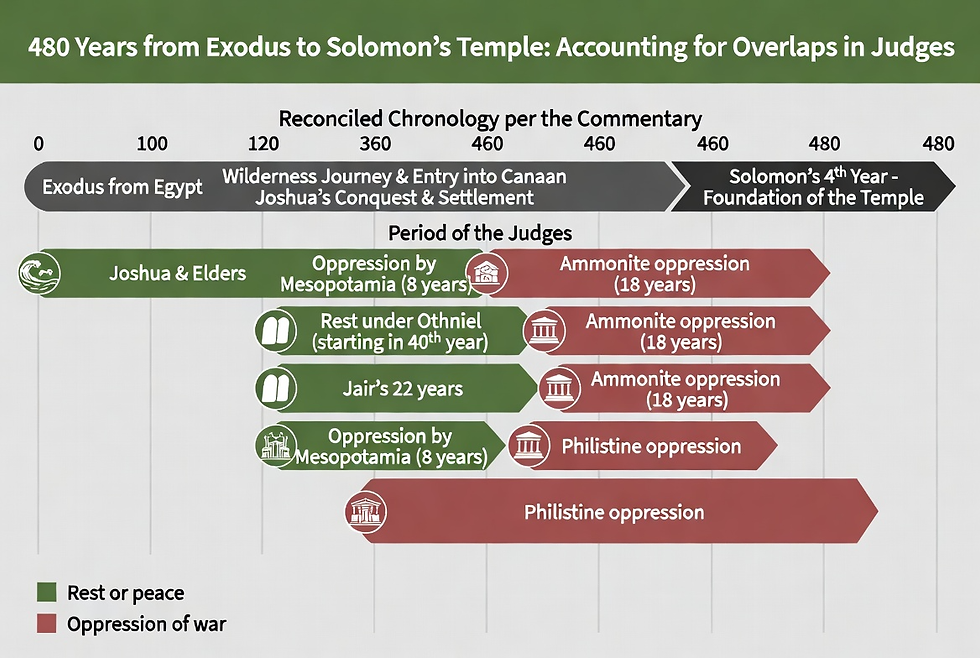
In the four hundred and eightieth year, etc.: This chronological difficulty is too vast and comprehensive to be fully discussed here, or to be determined by unlearned readers; and for the learned, I refer them to what is largely digested in my Latin Synopsis upon this place. It may suffice at present to suggest these particulars: 1. That Israel’s coming out of Egypt is variously understood in Scripture, and with some latitude, so as not only to note the time when first they came out of Egypt, but the time of their being in or coming out of the wilderness; as is manifest from Deuteronomy 4:45, where the words in the Hebrew are not after, etc., as we translate it, but in their coming forth out of Egypt:[51] and Psalm 114:1-3, When Israel came forth, etc.; Hebrew, their coming forth, etc.[52] And it is not impossible it may be so understood here, after they were come out, etc., to wit, completely, that is, towards the end of their expedition out of Egypt into Canaan. Nor doth the difference between the Hebrew prepositions ל/lamed and ב/beth, which a learned man objects, hinder this sense; for as ב/ beth signifies (as he saith) after, so also doth ל/lamed, Genesis 7:4,[53] 10;[54] Numbers 33:38.[55] 2. That whereas the times of the judges do chiefly cause this difficulty, there are many things which will relieve us therein; as, 1. That divers of the years there mentioned belong to one and the same time, as is evident from Jair’s twenty-two years,[56] within which fell out, as divers learned chronologers agree, the eighteen years of the oppression of the Ammonites, and several years of the Philistine tyranny, who oppressed Israel in the west, whilst the Ammonites vexed them in the east;[57] and the like might be observed in other cases. 2. That the years of rest are not necessarily to be understood of so many distinct years, besides those of war and servitude; and those words which are generally rendered the land had rest forty or eighty years, or the like, may be thus rendered, and that very agreeable to the Hebrew, The land had rest, or began to rest, or recovered its rest, in the fortieth or in the eightieth (the cardinal numbers being frequently put for the ordinal, especially where the number exceeds ten) year, to be computed from some remarkable time; and so that phrase doth not note how long time, or till what time, the rest continued, but at what time it began. As for instance, in Judges 3:11, the land had rest, not forty years, as it is in our translation, but in the fortieth year, to wit, from and after their first rest in, or quiet possession of, the land of Canaan, which Joshua gave them; which time may very probably be made up of the days of Joshua, after he had settled them in a state of rest; and of the elders that outlived him, Judges 2:7, and the time of their corruption after the death of those elders; and the eight years of servitude under the king of Mesopotamia. So Judges 3:30, The land had rest in the eightieth year, to wit, from and after that rest which Othniel obtained for them, Judges 3:11. And Judges 5:31, It rested in the fortieth year, to wit, after that rest got by Ehud, Judges 3:30. And Judges 8:28, It rested in the fortieth year, to wit, from the last rest got by Deborah. And thus the computation of years is more plain and certain, being thus made from rest to rest, than theirs that proceed the other way. And this is the more considerable, because it was the opinion of that famously learned and pious bishop of Armagh. All which considered, it will be very easy to contain all the parts and passages of sacred history, from the coming out of Egypt to this time, within the compass of four hundred and eighty years; of the several parcels whereof, see my Latin Synopsis. And as for other scriptures, which some conceit to be contradictory to this, I shall by God’s help vindicate them in their several places.
[In the fourth year, in the month Zif (which is the second month), of the reign of Solomon (similarly Montanus, Syriac, Arabic, Junius and Tremellius)] In the fourth year, in the month of April (it is the second month), in which Solomon began to reign, etc., he built, etc. (Pagnine, similarly Jonathan). In the fourth year, in the month Zif (it is the second month), in which Solomon reigned, etc. (Munster, Tigurinus). בְּחֹדֶשׁ זִ֗ו, in the month Zif, in the Month of April (Pagnine, Vatablus, Syriac, Arabic). It generally answers to April (Munster). Thus it has its name from splendor[58] (Vatablus). In the month of the opening of flowers (Jonathan in Vatablus). This name of the month, as also בּוּל/BUL in verse 38, is Chaldean. And by this it is proven that this book was written late, and perhaps by Jeremiah (Grotius). This is the second month, not of the reign of Solomon, but of whatever year, with respect had to the feasts, or sacred year (Menochius). Question: Why was this work put off for so long? Response: Besides the things that David left behind, many things had to be prepared, timbers cut, stones quarried and polished, etc. But why was it not undertaken in the first month? Response: It was impeded by the feast of Passover, which was held in that month (Martyr).
In the fourth year of Solomon’s reign; his three first years being spent partly in settling the affairs of his kingdom, without which neither civil nor ecclesiastical concerns could have any consistency; and partly in making necessary preparations for the work.
[He began to build, וַיִּבֶן] He built (Pagnine, Montanus, Jonathan); he began to build (Munster, Tigurinus, Junius and Tremellius, Syriac, Arabic). Thus it is explained in 2 Chronicles 3:1.[59] Thus Genesis 5:32, and 1 Kings 6:37 (Piscator out of Junius), the foundation of the house was laid, that is, began to be laid. Completive verbs are often to be understood inchoatively (Glassius’ “Grammar” 235).
He began to build; for so it is expressed 2 Chronicles 3:1; and so it is explained here below, 1 Kings 6:37, The foundation of the house was laid; though in the Hebrew it be only he built. Thus active words are oft understood of the beginning of the action, as Genesis 5:32; 11:26.
[To the Lord[60]] Unto the honor of Jehovah (Vatablus).
[1] Hebrew: וַיְהִ֣י בִשְׁמוֹנִ֣ים שָׁנָ֣ה וְאַרְבַּ֣ע מֵא֣וֹת שָׁנָ֡ה לְצֵ֣את בְּנֵֽי־יִשְׂרָאֵ֣ל מֵאֶֽרֶץ־מִצְרַיִם֩ בַּשָּׁנָ֙ה הָרְבִיעִ֜ית בְּחֹ֣דֶשׁ זִ֗ו ה֚וּא הַחֹ֣דֶשׁ הַשֵּׁנִ֔י לִמְלֹ֥ךְ שְׁלֹמֹ֖ה עַל־יִשְׂרָאֵ֑ל וַיִּ֥בֶן הַבַּ֖יִת לַיהוָֽה׃
[2] Hebrew: וַיִּבֶן.
[3] Nicolas Abram (1589-1655) was a French Jesuit theologian and classicist. He is remembered for his Pharo Veteris Testament (Beacon of the Old Testament), a multi-volume commentary, in which he treats chronological difficulties in uncommon detail.
[4] Michael Glycas (twelfth century) was a Byzantine theologian and historian. He served the court of Emperor Manuel I Komnenos as secretary. Glycas is most remembered for his Annalibus, a universal history for the creation to his own time.
[5] Melchior Cano (c. 1509-1560) was a Spanish Dominican theologian. He held the theological chair at Salamanca, and his abilities are amply demonstrated in his De Locis Theologicis.
[6] This refers to the Roman, or Sixtine (having been authorized by Sixtus V), edition of the Septuagint, published in 1585 to assist in the preparation of the new Vulgate edition ordered by the Council of Trent.
[7] Sulpicius Severus (c. 360-425) was a member of the Roman senatorial aristocracy, who renounced all for the monastic life. He wrote the first biography of Martin of Tours and the Chronicorum Libri Duo (or Historia Sacra), providing a history from the creation to 400 AD.
[8] Œcumenius was thought to have been a late tenth century bishop of Trikkala in Thessaly, but the authorship of the commentaries traditionally ascribed to him is confused. The commentaries on Acts and the Catholic Epistles are the same as those of Theophylact of Bulgaria (eleventh century); the commentary on the Pauline Epistles is older, copied in part from the work of Andrew of Cæsarea (563-637); the commentary on the Apocalypse appears to have been composed around the turn of the seventh century. Arethas of Cæsarea (ninth century) was a Greek Orthodox bishop and scholar. He compiled scholia on the Apocalypse, the oldest extant. Arethas’ comments on the Apocalypse were appended to the work of Œcumenius in this 1532 edition.
[9] Bede (c. 672-735), known as the Venerable Bede, was an English monk whose fame rests largely on his ecclesiastical history of England (c. 731). He wrote many other works, including commentaries, not only on the Heptateuch, but also on Kings, Esdras, Tobias, the Gospels, Acts, and the Catholic Epistles. His interpretive work is characterized by his commitment to the tradition of the Fathers, and by his use of the allegorical method of interpretation.
[10] Ruffinus was a fourth century churchman, a friend of Jerome turned foe, a commentator, and a monastery builder. His work in the translation of Greek patristic literature into Latin has proven to be of great importance, preserving works that would have otherwise been lost. There was a sixth-century Latin edition of Josephus’ Antiquities that was mistakenly attributed to Ruffinus.
[11] Sigismund Gelenius (1497-1554) was a Bohemian humanist and scholar. He worked as a translator and editor, producing new editions of ancient authors, including a major Latin edition of the works of Josephus.
[12] Carolus Sigonius (c. 1524-1587) was an Italian humanist scholar, historian, and philologist. He is remembered for his revision of the chronology of Roman history. Sigonius produced a new and emended edition of Sulpicius’ Chronica.
[13] Titus Flavius Clemens Alexandrinus (died c. 215) was the head of the Christian catechetical school in Alexandria, Egypt. He was trained in pagan philosophy before his conversion to Christianity.
[14] Stromata 1:22.
[15] Apology to Autolycus 3:22: “Then, concerning the building of the temple in Judæa which Solomon the king built five hundred and sixty-six years after the Exodus of the Jews from Egypt, there is among the Tyrians a record of how the temple was built. In their archives writings have been preserved which prove that the temple existed one hundred and forty-three years and eight months before the Tyrians founded Carthage.” Theophilus (died c. 183) was bishop of Antioch. Only his Apology to Autolycus is extant, which is filled with citations of the Scripture, drawn mostly from the Old Testament, but also from the New, with scattered Gospel references. Jerome mentions that he had read commentaries on the Gospels and Proverbs ascribed to Theophilus (although Jerome judged them inconsistent with Theophilus’ elegance of style).
[16] George Cedrenus was an eleventh century Byzantine historian. His Concise History of the World begins at the creation, and runs all the way through to his own day.
[17] Gerardus Joannes Vossius (1577-1649) was the father of Issac Vossius. He was a Dutch scholar of great distinction, particularly in the field of history.
[18] Chronologiæ Sacræ Isagoge.
[19] James Ussher (1580-1655) was an Irish churchman and scholar of the first rank, who eventually rose to the office of Archbishop of Ireland. He is most remembered for his Annals of the World.
[20] Johannes Funck (1518-1566) was German Lutheran chronologist and mathematician. He wrote Chronologia, covering world history from creation, in which he includes detailed Biblical timelines, and addresses discrepancies.
[21] Gerhardus Mercator (1512-1594) was a renowned Belgic geographer and cartographer. Although he was clearly sympathetic to Lutheranism, he never declared himself, but did move from Catholic Leuven to tolerant Duisburg. He wrote Chronologiam, synchronizing sacred and secular history using biblical data and astronomical observations.
[22] Heinrich Bunting (1545-1606) was German Lutheran pastor, cartographer, and chronologist. His major work, Itinerarium et Chronicon Ecclesiasticum Totius Sacræ Scripturæ, was a Biblical geography, complete with chronological tables.
[23] William Perkins (1558-1602) was an influential English Puritan theologian, preacher, and biblical scholar at Cambridge, often called the “father of Puritanism”. His A Digest or Harmony of the Old and New Testaments was a precursor to Ussher’s Annals.
[24] Thomas Lydiat (c. 1572-1646) was an Anglican churchman, mathematician, and chronologist, fellow of New College, Oxford. His extensive work in chronology influenced Ussher, and brought him into controversy with Scaliger.
[25] Philippus Lansbergius (1561-1632) was a Flemish-born Dutch Calvinist pastor, mathematician, astronomer, and chronologist. He wrote Chronologiæ sacræ, and a number of works on astronomy.
[26] Lorenz Codomann (1529-1590) was a German Lutheran pastor, theologian, and chronologist. He is remembered for his Annalibus Sacræ Scripturæ, a detailed Biblical chronology. An abridged English translation was published under the title, Chronographia: A Description of Time, from the Beginning of the World.
[27] Dionysius Petavius (1583-1652) was a Jesuit scholar and theologian. He served as Professor of Theology at Paris (1621-1643). He composed a major work on Biblical chronology, Opus de Doctrina Temporum.
[28] Petrus Possinus (1609-1686) was a French Jesuit priest, historian, translator, and editor, publishing new editions of a number of historical and patristic texts. He was a disciple of Petavius.
[29] Deuteronomy 4:45: “These are the testimonies, and the statutes, and the judgments, which Moses spake unto the children of Israel, after they came forth out of Egypt (בְּצֵאתָ֖ם מִמִּצְרָֽיִם׃, in their coming forth out of Egypt)…”
[30] Genesis 35:9: “And God appeared unto Jacob again, when he came out (בְּבֹאוֹ, after he had come out) of Padan-aram, and blessed him.”
[31] Exodus 2:23: “And it came to pass in process of time (בַיָּמִ֙ים הָֽרַבִּ֜ים הָהֵ֗ם, after these many days), that the king of Egypt died: and the children of Israel sighed by reason of the bondage, and they cried, and their cry came up unto God by reason of the bondage.”
[32] Numbers 28:26: “Also in the day of the firstfruits, when ye bring a new meat offering unto the Lord, after your weeks (בְּשָׁבֻעֹתֵיכֶם), ye shall have an holy convocation; ye shall do no servile work…”
[33] Exodus 16:1: “And they took their journey from Elim, and all the congregation of the children of Israel came unto the wilderness of Sin, which is between Elim and Sinai, on the fifteenth day of the second month after their departing (לְצֵאתָם) out of the land of Egypt.”
[34] Exodus 19:1: “In the third month, when the children of Israel were gone forth (לְצֵ֥את בְּנֵי־יִשְׂרָאֵ֖ל) out of the land of Egypt, the same day came they into the wilderness of Sinai.”
[35] Numbers 33:38: “And Aaron the priest went up into mount Hor at the commandment of the Lord, and died there, in the fortieth year after the children of Israel were come (לְצֵ֤את בְּנֵֽי־יִשְׂרָאֵל֙) out of the land of Egypt, in the first day of the fifth month.”
[36] See Judges 9.
[37] Judges 10:1, 2.
[38] Judges 10:3-5.
[39] James Gordon (c. 1541-1620) was a Scottish Jesuit, remembered for his contributions in the field of Biblical chronology.
[40] Augustine Torniellus (1543-1622) was a member of the Society of Barnabites, a Counter-Reformation order. His work, Annales Sacri et Profani, cleared up many geographical and chronological difficulties and obscurities, especially in the Old Testament.
[41] Judges 12:7-15.
[42] De Templo et de Iis quæ ad Templum Pertinent, Libri Quinque.
[43] Judges 3:31.
[44] That is, things expressed out of chronological order.
[45] Judges 12:7.
[46] Judges 12:8-15.
[47] The Alexandrian text-type is generally supportive of this reading.
[48] That is, Codex Alexandrinus, a fifth century Uncial of the Alexandrian text-type. Patriarch Cyril Lucar of Constantinople gifted this manuscript to King Charles I in 1627.
[49] Codex Bezæ Cantabrigiensis is a fifth century Uncial of the Western text-type. Theodore Beza gifted it to Cambridge University in 1581.
[50] Robertus Stephanus, or Robert Estienne (1503-1559), was a printer in Paris, with skill in Hebrew, Greek, and Latin. He employed his considerable talents in the production of multiple editions of the Bible in each language. His work on the Greek text of the New Testament was particularly important in the formation of the Textus Receptus, and he did important critical work on the Vulgate.
[51] Deuteronomy 4:45: “These are the testimonies, and the statutes, and the judgments, which Moses spake unto the children of Israel, after they came forth out of Egypt (בְּצֵאתָ֖ם מִמִּצְרָֽיִם׃, in their coming forth out of Egypt)…”
[52] Psalm 114:1-3: “When Israel went out of Egypt (בְּצֵ֣את יִ֭שְׂרָאֵל מִמִּצְרָ֑יִם, in the going forth of Israel out of Egypt), the house of Jacob from a people of strange language; Judah was his sanctuary, and Israel his dominion. The sea saw it, and fled: Jordan was driven back.”
[53] Genesis 7:4: “For yet seven days (כִּי֩ לְיָמִ֙ים ע֜וֹד, for after seven days more), and I will cause it to rain upon the earth forty days and forty nights; and every living substance that I have made will I destroy from off the face of the earth.”
[54] Genesis 7:10: “And it came to pass after seven days (לְשִׁבְעַ֣ת הַיָּמִ֑ים), that the waters of the flood were upon the earth.”
[55] Numbers 33:38: “And Aaron the priest went up into mount Hor at the commandment of the Lord, and died there, in the fortieth year after the children of Israel were come out of the land of Egypt (לְצֵ֤את בְּנֵֽי־יִשְׂרָאֵל֙ מֵאֶ֣רֶץ מִצְרַ֔יִם), in the first day of the fifth month.”
[56] Judges 10:3-5.
[57] See Judges 10:7, 8.
[58] זִו/Ziv signifies brightness, or freshness.
[59] 2 Chronicles 3:1: “Then Solomon began to build (וַיָּ֣חֶל שְׁלֹמֹ֗ה לִבְנ֤וֹת) the house of the Lord at Jerusalem in mount Moriah, where the Lord appeared unto David his father, in the place that David had prepared in the threshingfloor of Ornan the Jebusite.”
[60] 1 Kings 6:1b: “…he began to build the house of the Lord (לַיהוָה, to the Lord).”


Fisher's Catechism: Q. 40.37. What were the sacred places under the old dispensation?
A. The tabernacle and temple.
Q. 40.38. What was the tabernacle?
A. It was a movable and portable tent, secured from the injuries of the weather, by several coverings; the whole planned by God himself, and executed by Moses in the wilderness, precisely according to the pattern showed him on the mount, Heb 8:5.
Q. 40.39. How was it enclosed?
A. By a large or spacious court, open above, but hung round with curtains of fine twined linen, five cubits, or seven and a half feet high, Exod 27:18.
Q. 40.40. When and where was the temple built?
A. It was built by Solomon, at Jerusalem, on…
Matthew Henry: 'Here, I. The temple is called the house of the Lord (1 Kings 6:1), because it was, 1. Directed and modelled by him. Infinite Wisdom was the architect, and gave David the plan or pattern by the Spirit, not by word of mouth only, but, for the greater certainty and exactness, in writing (1 Chron 28:11-12), as he had given to Moses in the mouth a draught of the tabernacle. 2. Dedicated and devoted to him and to his honour, to be employed in his service, so his as never any other house was, for he manifested his glory in it (so as never in any other) in a way agreeable to that dispensation; for, when there wer…
Follow the translation of Matthew Poole's Synopsis on 1 Kings!
https://www.fromreformationtoreformation.com/1-kings
An Old Testament Survey!
www.fromreformationtoreformation.com/old-testament-survey-class-page
Lampe's History of the United Kingdom under David and Solomon!
https://www.fromreformationtoreformation.com/post/lampe-on-church-history-the-church-under-kings-before-the-division