De Moor IX:17: The Office of Angels, Part 2

[We could use your help: If you are being blessed by the translation work, please consider supporting the work and speeding it on its way. Click here to watch a brief video on the project.]

On this controversy consult CALVIN’S Institutes of the Christian Religion, book I, chapter XIV, § 7; SPANHEIM’S Dubia Euangelica, part III, Doubts LXI, LXII, pages 273-279; VOETIUS’ de Angelis Tutelaribus, Disputationum theologicarum, part I, pages 897-905; and ODÉ, who most thoroughly handles this argument, Commentario de Angelis, section VIII, chapters III, IV, where in chapter III, pages 771-845, he discourses concerning the Ministry that Angels render to God in the administration of the World and of the Church, and in chapter IV, pages 845-895, concerning the Ministry that Angels render to Men.
2. Particular Intercession for Men, and that Efficacious with respect to their Merits. Thus the Papists, in Catechismo Tridentino ad Parochos, part III, ad Præconios, part I, Decalogue, § 24, urge, that for that reason Saints, Angels, and Blessed Souls are all the more to be worshipped and invoked, because they assiduously pray for the salvation of men, and God confers upon us many blessings on account of their merit and favor. Whence Drexelius the Jesuit[1] in his Opusculo, which is inscribed Memoriale Æternitatis, prays to God the Father through the merits of Christ, the Blessed Virgin, and his Guardian Angel.
The Papists recall this error from the pits, α. of the Gentiles, among whom PLATO in his Symposio said, as cited by STEUCHUS EUGUBINUS in his de perenni Philosophia, book VIII, chapter XXII: Indeed, the entire race of Dæmons comes between God and mortals, relating human affairs to the gods, and divine affairs to men: indeed, the prayers and sacrifices of men: the commands of the gods, and rewards for the sacrifices. And, since it is in the midst of both, it brings it to pass that the universe is bound cohesively together.
β. Of the Jews, among whom PHILO the Jew, in libro de Somniis, discoursing concerning Spirits of various sorts, writes, page 586, Ἄλλαι δ᾽ εἰσιν καθαρώταται καὶ ἄρισται, μειζόνων φρονημάτων καὶ θειοτέρων ἐπιλαχοῦσαι, μηδένος μὲν τῶν περιγείων ποτὲ ὀρεχθεῖσαι τὸ παράπαν, ὕπαρχοι δὲ τοῦ πανηγεμόνος, ὥσπερ μεγάλου βασιλέως ὀφθαλμοὶ καὶ ὦτα, ἀφορῶσαι πάντα καὶ ἀκούουσαι· ταύτας δαίμονας μὲν οἱ ἄλλοι φιλόσοφοι, ὁ δὲ ἱερὸς λόγος ἀγγέλους εἴωθε καλεῖν, προσφυεστέρῳ χρώμενος ὀνόματι. καὶ γὰρ τὰς τοῦ πατρὸς ἐπικελεύσεις τοῖς ἐκγόνοις, καὶ τὰς τῶν ἐκγόνων χρείας τῷ πατρὶ διαγγέλλουσι. Παρ᾽ ὃ καὶ ἀνερχομένους καὶ κατιόντας αὐτοῦς εἰσήγαγεν, —ὅτι τοῖς ἐπικήροις ἡμῖν συνέφερε μεσίταις καὶ διαιτηταῖς λόγοις χρῆασθαι, etc., There are also others, the purest and best of all, having attained a better and more divine frame, never at all desiring any earthly things whatsoever, but belonging as ministers to the Almighty, like the eyes and ears of a great king, beholding all things and hearing all: These other philosophers are wont to call dæmons, but the Holy Word is wont to call them angels, employing a more fitting name: For they are messengers, carrying the Father’s commands to his offspring, and the needs of the offspring to the Father: For this reason also it has presented them as ascending and descending (Genesis 28:12)—because it was beneficial for us mortals to have mediators and arbitrators in discourse, etc. MILL,[2] Dissertationibus selectis X, § 45, also shows from the writings of the Jews, that with great unanimity they teach, that Angels intercede for mortals before God, and render Him, burning with anger over sins, favorable to them. At the same time, in MAIMONIDES on Codicem Sanhedrin, chapter XI, in the fifth article of the Jewish faith, we read: There is to be no serving of the creature, so that by their help we might draw near to God, but our attention is upon Him alone, with all but Him abandoned; and this fifth foundation stands mightily against idolatry, concerning which everywhere in the Law: see SURENHUSIUS’ Mischnam, part IV, page 263.
γ. And of the ancient Heretics, just as our AUTHOR, discoursing concerning the Papists in Oration II after Exercitationes Miscellaneas, page 433, has: “They make use of Angels and Saints as Mediators, in imitation of those Angelic, concerning whom Chrysostom in his commentary on the text of the Apostle treats, who say that we are reconciled to God, not through Christ, but through Angels, and also as many as, trusting in heavenly intercession, were prone to the adoration of heavenly beings.”
We deny this Particular Intercession of Angels, and the Merits of the same for Men:

α. Because this is opposed to the Glory of Christ, who is commended in the Scriptures as our only παράκλητος/advocate, Hebrews 7:25; 1 John 2:1:[3] John sets this before believers as an eminent consolation; but if there were many παράκλητοι/advocates, the Apostle would not have passed over this opportunity to enlarge the consolation of believers. Intercession is a part of the mediatorial office, but Paul acknowledges only one Mediator between God and men, 1 Timothy 2:5; neither does Scripture know the distinction between the primary and principal Mediator and secondary and ministerial Mediators; and there is no need for the latter, when the former is sufficient of Himself.
β. Because Angels do not have Merit, upon which their Intercession is able to rest. They did not make Satisfaction and ἱλασμὸν/ propitiation for our sins,[4] whereby their Intercession might be able to be rendered certainly efficacious; which two things, nevertheless, Scripture conjoins as inseparable offices of our Mediator and Priest, and so it comforts believers with the παρακλήσει/advocacy/consolation of our Advocate, because He is the ἱλασμὸς/propitiation for our sins, for which He was delivered to death, 1 John 2:1, 2; Romans 8:33, 34. And, when we saw in § 16, that Merit properly so called ought to be denied to Angels, what then have they merited for men? Bellarmine,[5] book V de Justificatione, chapter X, Controversiis, tome 4, column 1284, among other conditions of Merit, requires, that the one meriting be a Wayfarer/ Pilgrim: and de Gratia primi hominis, chapter XVIII, in the same place, column 59, he asserts, that the Period of Wayfaring and Merit was exceedingly brief in the case of the Angels. But, that in that brief space of time there was such a redoubling of angelic Merits, so that they not only obtained Confirmation for themselves, but also the surplus of their Merits was overflowing to Men, who thereafter would be delivered into their special Care and Keeping; no one will easily persuade himself.
γ. Because they were not furnished with sufficient Knowledge, which is a prerequisite in Particular Intercession of this sort. To them is wanting a sufficient Knowledge of our Necessities; in Heaven the Angels of the little ones continually behold the face of God, Matthew 18:10, awaiting God’s orders, to be executed in His name on earth for the welfare of the little ones: we do not read, that on this earth they reciprocally seek out what might be for the advantage of the pious, so that by their Prayers they might convey this to God for His gracious fulfillment. Since καρδιογνωσία, knowledge of the heart,[6] is wanting to them, they are also ignorant of the secret prayers of the pious, conceived in the mind alone, which consequently they are not able to convey to God; neither are they able always to judge rightly concerning the sincerity of the heart of those praying, so that they might rightly commend the answering of the prayers of those that humbly supplicate God.
And against this Want of Knowledge altogether gratuitously do the Papists seek Refuge, 1. in the Revelation of God: for thus they rashly suppose, α. that the Revelation made to Angels extends to any and all necessities and prayers of believers. β. That the particular Necessities of believers are revealed to Angels for this reason, that in heaven they might manage their cause before God, by interceding for them: while, on the other hand, Scripture testifies, that the Ministry of Angels towards believers consists in this, that they are sent down from heaven to earth, so that there they might care for believers by coming to their aid, Hebrews 1:14.
2. Or in the Narration of others, which specific and particular Narration, again, they ought not to suppose, but to prove.

3. Or in the Mirror of the Trinity, concerning which I have already spoken in § 8; but if from the Vision of God attributed to them in Matthew 18:10 it should follow, that the Angels know whatever God knows, the Angels would also be altogether omniscient, which nevertheless Bellarmine denies, de Sanctorum Beatitudine, book I, chapter XX, Controversiis, tome 2, columns 914, 915; likewise Petavius,[7] Theologicis Dogmatibus, tome 3, book I, de Angelis, chapter VII and following.
Objection α: We read of Angels interceding in Job 33:23, 24; Zechariah 1:12; Revelation 8:2, 3. I Respond: The Commentarius of our AUTHOR is able to be consulted on each one of the three Passages cited here.
1. The Passage in Job 33:23, 24, which our AUTHOR explains in his Mantissa Observationum Textualium after his Analysin Exegeticam of Isaiah 53, Text III, pages 389-397, does not make for proof of the Intercession of good Angels for the pious; since this, a. rests upon the hypothesis of, and is furnished with efficacy by, a Guardian Angel for each and every one: but that Angel, concerning whom Elihu speaks, is distinguished from the rest, and the work attributed to this Angel is indicated to be applicable to only one altogether exceptional Angel, when he is described as אֶחָ֥ד מִנִּי־אָ֑לֶף, one among a thousand. b. But, these words of Elihu, says our AUTHOR, are piously and suitably explained either of the office of God’s approved ministers in general with respect to all things, or partly of this office, partly of God’s grace pursuant to this office; one or the other of which Interpreters commonly hold. And indeed, the latter pleases the DUTCH TRANSLATORS, whose notes, but which render the sense more diluted and forced, yet are strongly approved by MARESIUS, Systemate Theologico X, § 53, note c, the Reader is able to consult. Yet to me, proceeds our AUTHOR, my own hypothesis is preferable to those of others; namely, that there is a treatment of Christ here, and His office concerning men, even indeed with this twofold verse to be referred back to the aforementioned condition, and finally with the fruit to be subjoined in verse 25 and following. The greater emphasis of the individual words urges this; and the faith of the pious Fathers in Christ as their Savior, one and perfect, and the no less infallible certainty of the joyful outcome here mentioned, persuade of this. There are two things especially that quite emphatically apply to Christ, and, unless they be referred to Him, must ever be explained by a more diluted and forced sense, namely, a. that the Angel in verse 23 is described asמַלְאָ֗ךְ מֵלִ֗יץ אֶחָ֥ד מִנִּי־אָ֑לֶף, a messenger/angel, an interpreter, one among a thousand; b. that the Angel in prayer to God in verse 24 says, מָצָ֥אתִי כֹֽפֶר׃, I have found a ransom. See also WITSIUS’ Œconomia fœderum, book IV, chapter III, § 31-38; and ODÉ’S Commentarium de Angelis, section X, § 32, pages 1046-1049.
2. In Zechariah the description of that Angel, a. both in the emblematic vision, verse 8, of a man standing among the myrtle trees, carried by a red horse, with various horses behind Him; b. and in the threefold mediatorial Office, prophetic, priestly, and royal, in which the whole context respresents Him: with sufficient clarity leads us to the uncreated Angel, the Messiah: although, according to the observation of our AUTHOR, that general request on behalf of the afflicted cities of Judah and Jerusalem, verse 12, is able to be attributed to some created Angel, as it has been done by many of the Ancients and the More Recent, without the consequence of the Particular Intercession of Angels and Blessed men, and of the Papistical Invocation of these.
3. In Revelation 8:3, with many of the Papists, BEZA himself holds that other Angels standing before the Altar as a created Angel, and writes that the prayers of the saints are offered to God through the ministry of the Angels. Which our AUTHOR thinks all the less to be condoned in BEZA, because ZEGERUS,[8] with other Papists, concedes that the description of this Angel is not applicable to created spirits. Neither is our AUTHOR satisfied with the interpretation of the Angel as the Holy Spirit, since He does not come under this notion, and He helps our prayer from within, not from without: although LAMPE then attempts to shore up that exegesis with various arguments, which you may read in his Dissertationum philologico-theologicarum, volume II, Disputation IX, chapter X, § 38-40, pages 351-354. Therefore, that other Angel is Christ, the true Priest and our High Priest, represented here in His sacerdotal office, quite frequently also elsewhere simply called the Angel, manifestly enough distinguished from all created angels here and in Revelation 7:2 by the epithet another: since to offer incense, and the prayers of all Saints, is applicable to no other; just as of old it was not lawful for anyone to offer incense, unless appointed to the office of Priest.
Neither ought Exception to be taken, a. That this Angel is found here Standing. I Respond, that thus He is fittingly represented in His sacerdotal Office.
Nor ought Exception to be taken, b. That this Angel is distinguished by the golden Altar, which is Christ. I Respond, that Christ is the body of all shadows,[9] and many types have regard to Him at the same time, in such a way that He is able to be represented, according to various σχέσεις/relations, both by the Priest offering incense and by the Altar of incense.
Nor ought Exception to be taken, c. That incense is given to this Angel, which could not be said of Christ as High Priest: καὶ ἐδόθη αὐτῷ θυμιάματα πολλά, ἵνα δώσῃ ταῖς προσευχαῖς τῶν ἁγίων πάντων ἐπὶ τὸ θυσιαστήριον τὸ χρυσοῦν τὸ ἐνώπιον τοῦ θρόνου, and there was given to Him much incense, that He should offer it with the prayers of all saints upon the golden altar which was before the throne. I Respond, 1. COCCEIUS and others interpret this of Christ’s Merits smelling sweetly before God, which might be said to be given to Christ through the approbation of the Father. 2. But our AUTHOR believes, that the many incenses are afterwards explained of the various and numerous prayers of all saints without any distinction, which accordingly were given to the Priest then approaching and standing at the Altar, not by the one sitting upon the throne, to whom they were being offered, but by those whose prayers they were; to this end, that He might give or place the same upon the golden Altar. Thus the posited ταῖς προσευχαῖς τῶν ἁγίων, with the prayers of the saints, is believed to be in the place of ἐν ταῖς προσευχαῖς, consisting in the prayers, according to the Hebrew use of the ב/on/in of the matter/material of a thing, which was quite frequently omitted. Similarly, again in verse 4, καὶ ἀνέβη ὁ καπνὸς τῶν θυμιαμάτων ταῖς προσευχαῖς τῶν ἁγίων, and the smoke of the incense with the prayers of the saints ascended, is explained by our AUTHOR: and ascended the smoke of the incenses in the prayers of the saints, that is, of those incenses that were constituted of the prayers of the saints. Unless we should say with WITSIUS, whom see at greater length in his Miscellaneorum Sacrorum, tome 1, book II, dissertation II, § 94, that to the Incense correspond the prayers; it appears that prayers of two sorts are here mentioned; both those proper to the Angelic Priest, which might be called many incenses, and those of the Saints, to which the Angelic Priest adds His own. That many Incenses are able to be said to be given to Christ, either, 1. with respect to God the Father, who entrusted the office of High Priest to Christ, and for this reason holds His intercessory prayers as altogether pleasing: or, 2. relatively to the various states of the Church, whereby the occasion of prayers is furnished to Christ: or, 3. simply with an allusion to the ancient custom, wherein, from the mass of incenses prepared for the entire year, a certain measure was given to the Priest on his way to offer incense, whether by the Prefect of the temple, or by some other, upon whom that stewardship was incumbent. That these Incenses by the Angel were given, that is, added, to the prayers of all saints, as much those that are in heaven, as those that are even now on earth, whose prayers have all their fragrance, favor, and power, from the Intercession of Christ; who offers to the Father these prayers, entrusted to Himself, and conjoined with His own, and brings it to pass that they are accepted: compare also SPANHEIM the Elder’s[10] Disputationes Anti-Anabaptisticas VIII, § 34.
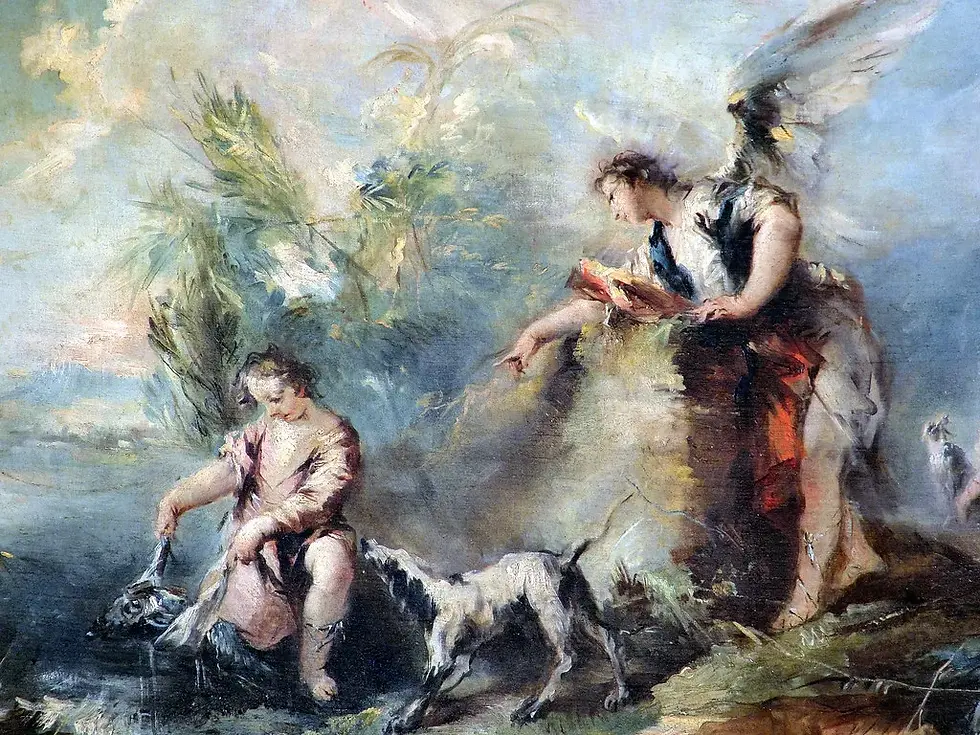
Objection β: The testimony of the masked Azarias, Tobit 12:12, 15, Now therefore, when thou didst pray, and Sara thy daughter-in-law, I did bring the remembrance of your prayers before the Holy One… I am Raphael, one of the seven holy Angels, which present the prayers of the saints, and which go in and out before the glory of the Holy One. Our AUTHOR responds, 1. that the book is Apocryphal, to which then is not applicable authenticity for proving doctrines of faith; see Chapter II, § 19, 20. 2. Neither does the Angel deserve any further credit, who once lied in that matter, that he is a man: namely, in Tobit 5, where he says, I am Azarias, the son of Ananias the great, one of the brethren of Tobit’s brethren, verses 4-22. 3. Now, the names of these seven Angels, who are the primary Ministers of God, and the principal Mediators of men before God, ODÉ relates out of the Papists, but with a critique added, Commentario de Angelis, section VIII, chapter I, § 13, pages 750, 751.
Objection γ: Luke 15:7, 10: οὕτω χαρὰ ἔσται ἐν τῷ οὐρανῷ ἐπὶ ἑνὶ ἁμαρτωλῷ μετανοοῦντι, etc… χαρὰ γίνεται ἐνώπιον τῶν ἀγγέλων τοῦ Θεοῦ ἐπὶ ἑνὶ ἁμαρτωλῷ μετανοοῦντι, likewise joy shall be in heaven over one sinner that repenteth, etc… There is joy in the presence of the angels of God over one sinner that repenteth. For, from this passage argues the Catechismus Tridentinus ad Parochos, part III, on Precept 1 of the Decalogue, § 25, in this way: For, if there is joy in heaven over one sinner repenting, will not the citizens of heaven assist those repenting? having been invoked, will they not obtain the pardon of sinners and the grace of God for us? Similarly the Walenburg Brothers,[11] Compendio Controversiarum, chapter XVIII: For the Angels were not rejoicing over a thing unknown, or over the conversion of sinners only in general, but over one particular and determinate sinner. Let the Protestant Gentlemen explain to us, what and of what sort that joy of Angels is, and whence conceived, if they be ignorant of the conversion of the sinner: let them explain to us, whether they have that knowledge by natural ability, or by a gift of grace. We ourselves do indeed suppose, that there is not going to be any one among them, who would solidly determine that mode of angelic cognition, and not at the same moment posit the very thing that confirms the opinion of the Catholics.
Our AUTHOR responds, Exercitationibus Textualibus XXXII, Part I:
1. That the case here is singular and joyous, upon which follows, not some Intecession for the necessities of those dwelling on the earth, but the Praise of God; namely, the Conversion of some extraordinarily great sinner, who would need more than others a singular repentance, verses 1, 2, in which all God’s wideom, power, goodness, and glory would be so clearly demonstrated. If a case of such a sort become known, no matter in way way, to the heavenly Angels, from this to the singular necessities and prayers of all no legitimate conclusion is able to be drawn.
2. That the joy here is not directly attributed to the Angels, but to the Triune God Himself; who alone has dominion over repenting sinners, after the likeness of the rejoicing shepherd and widow; who verily brings back the straying sinner; who has established His throne in heaven, so that the joy in heaven, verse 7, is most suitable understood of God Himself; in whose sight, since the Angels attend continually as ministers, the joy of God is for good reason said to be before the Angels of God, so that these are expressly said to be witnesses, rather than subjects, of that joy, according to the common usage of the Greek expression in Luke.[12]
3. That the participation of the Angels in this Joy, which, not so much this expression, but the preceding parable, appears to indicate, is derived wholly from the solemn declaration and calling of the Lord; neither is it considered as conjoined with the very same moment in time with the repentance, but rather as following after it: if you consider how many things come between the finding of the sheep and the joy the acquaintances. Χαρὰ γίνεται, there is joy, is an indefinite expression in verse 10, in the place of which, in verse 7, in the future tense is χαρὰ ἔσται, there shall be joy. And so our AUTHOR thinks, that that Joy of the Angels is able suitably to be referred, either to the hour of the death of the repenting sinner, in which he is introduced by the Lord into His heavenly household, forever exempt from all danger of straying; or to the time of the final Judgement, when the Lord Himself shall confess His own before the Angels of God, Luke 12:8, with the separation of the same from the impious demanded of the Angels, Matthew 13:41, 49. So that from this future Joy of the Angels, which will proceed from the certain and determinate revelation of God, no present knowledge of the necessities and prayers of individual inhabitants of the earth is able to be concluded.
On this controversy consult ODÉ, Commentario de Angelis, section VIII, chapter I, § 10-15, pages 748-753.
[1] Jeremias Drexel (1581-1638) was a Jesuit scholar, preacher (to Maximilian I, Elector of Bavaria), and professor of the humanities at Dillingen. He was born in Augsburg to a Lutheran family, but converted to Catholicism.
[2] David Mill (1692-1756) was a Dutch Orientalist and Reformed Theologian. He served as Professor of Oriental Languages (1718-1727), and as Professor of Hebrew Antiquities (1727-1756) at Utrecht.
[3] 1 John 2:1: “My little children, these things write I unto you, that ye sin not. And if any man sin, we have an advocate (παράκλητον/paraclete) with the Father, Jesus Christ the righteous…”
[4] 1 John 2:2: “And he is the propitiation (ἱλασμός) for our sins: and not for ours only, but also for the sins of the whole world.”
[5] Robert Bellarmine (1542-1621) entered the Order of the Jesuits in his late teens. He became one of the great theologians of his era, a Cardinal, and, after his death, a Doctor of the Church.
[6] Acts 1:24: “And they prayed, and said, Thou, Lord, which knowest the hearts of all men (καρδιογνῶστα πάντων), shew whether of these two thou hast chosen…” Acts 15:8: “And God, which knoweth the hearts (ὁ καρδιογνώστης Θεὸς), bare them witness, giving them the Holy Ghost, even as he did unto us…”
[7] Denis Petau (1583-1652) was a French Jesuit churchman, scholar, and educator. He had particular expertise in chronology, rhetoric, philosophy, dogmatic theology, and patristics.
[8] Nicholas Tacitus Zegers (c.1495–1559) was a Flemish Franciscan scholar. Due to the impact and influence of Francis Titelmans Biblical scholarship, Zegers gave himself to the mastery of the rudiments of Biblical interpretation, and then served as the Chair of Exegeis at Leuven. He wrote Scholion in omnes Novi Testamenti libros.
[9] Colossians 2:16, 17.
[10] Friedrich Spanheim the Elder (1600-1649) studied at Heidelberg and Geneva. He served the academy at Geneva, first as Professor of Philosophy, then as a member of the theological faculty, and finally as rector. In 1642, he was appointed as Professor of Theology at Leiden, and became a prominent defender of Calvinistic orthodoxy against Amyraldianism.
[11] The Walenburg Brothers were seventeenth century Dutch Roman Catholic apologists. Adrian van Walenburch (1609-1669) and Peter van Walenburch (1610-1675) both served as Bishop of Cologne. They developed an “Augustinian Method” of defending Roman Catholic doctrine from Scripture and antiquity alone.
[12] Greek: ἐνώπιον τῶν ἀγγέλων τοῦ Θεοῦ.


See Wendelin's shorter treatment of the Doctrine of Angels!
www.fromreformationtoreformation.com/introductory-theology
Or, get the book! https://www.lulu.com/shop/steven-dilday/wendelins-christian-theology-volume-1/hardcover/product-yv54k5p.html?srsltid=AfmBOorEjy-Ia6DnMaLvqBdQbsDD_Uy8hj2ZKGyxUTu-TuT_6p1nRZJ0&page=1&pageSize=4
Study the Doctrine of Angels with De Moor!
www.fromreformationtoreformation.com/de-moor-on-angels