Poole on 1 Kings 8:9-11: The Bringing of the Ark into the Temple, Part 3

Verse 9:[1] (Ex. 25:21; Deut. 10:2) There was nothing in the ark (Deut. 10:5; Heb. 9:4) save the two tables of stone, which Moses (Ex. 40:20) put there at Horeb, (Ex. 34:27, 28; Deut. 4:13; 1 Kings 8:21) when (or, where[2]) the LORD made a covenant with the children of Israel, when they came out of the land of Egypt.

[In the ark there was nothing except the two tables] Objection: In Hebrews 9:4, καὶ τὴν κιβωτὸν, etc., ἐν ᾗ στάμνος, etc., and the ark…wherein was the pot…and Aaron’s rod…and the tables, etc. Response 1: In the time of the Tabernacle, the rod and the pot were in the ark; for they were not able to be situated more suitably in that unfixed condition: but, when the Temple was built, that fixed and luxurious domicile, they were taken out of the ark, so that thereafter they might be kept in their own seats, stored, as it were, in treasuries (Sanchez). The Apostle speaks concerning the ark, as it was in the time of Moses (Martyr). Response 2: That relative ἐν ᾗ, wherein, is not to be referred to the closer κιβωτὸν/ark, but to the more remote σκηνὴ/tabernacle, so that all those things are understood to be in the tabernacle, not in the ark (Junius in Dieu, similarly Lyra, Cajetan, Tostatus, Ribera and Azor in Sanchez). Certainly in the tabernacle, not in the ark, did God command them to be kept, Exodus 16:33; Numbers 17:10 (Sanchez). To this opinion is opposed what follows, ὑπεράνω αὐτῆς Χερουβὶμ, etc., over it the Cherubim, etc., which certainly are referred to the same as that ἐν ᾗ, wherein, namely, to the ark, just as both the Syriac and Arabic take it there (Dieu, similarly Sanchez). Response 3: That רַק/only/save does not exclude the pot and the rod: but the sense is, that Nothing else, namely, of the whole law, was contained in the ark, except, etc. But, that the other laws were kept outside of the ark in the tabernacle, is evident from Deuteronomy 31:26. See also 2 Chronicles 34:14 (Sanchez). Response 4: The preposition ἐν is to be expounded in two ways: namely, by in, to the extent that it is referred to the tables; and by near, to the extent that it is referred to the remaining two. But the use of in in the place of near is found frequently in the sacred books: Thus in this very verse, בְּחֹרֵב, in Horeb, is in the place of at or near Horeb. For he did not place the tables in the ark in mount Horeb itself; but in the camp, as it is evident from Exodus 40 (Piscator). And the ב in Hebrew and the ἐν in Greek do not always denote a thing that is within another thing, but also what is contiguous with, and attached to, another thing, as in Genesis 1:22, and let fowl multiply בָּאָרֶץ, in the earth, not within, but upon, etc. Christ sits ἐν δεξιᾷ, in the right hand; that is, at the right hand.[3] Thus to the Latin he is said pendere in ligno, to hang in a tree,[4] who is hanged upon a tree. Thus in this passage, I say that those three things were in the ark, but in diverse ways: the tables were in, that is, within the ark: the pot and rod were in, that is, by the ark (Dieu on Hebrews 9:3): but it seems harsh, to change the signification of one and the same word once placed in a particular passage; and to take the in in one way in one place, and another way in the other: while it is applied in exactly the same manner to both (Sanchez). [But concerning these things, more is to be said, should the divine favor bring our labors along to that passage.]
Nothing in the ark; strictly and properly: for in a more large sense, as in is oft taken for by or near, as is confessed, and hath been proved before; so the pot of manna and Aaron’s rod were also in it, Hebrews 9:4, that is, by it, to wit, in the most holy place, before the ark of the testimony, where God commanded Moses to put them, as it is expressed, Exodus 16:33, 34; Numbers 17:10, and not strictly in it. But of this more, God assisting, on Hebrews 9:4.
[Which Moses had placed in it in Horeb, when the Lord settled the covenant with the children of Israel, אֲשֶׁ֙ר כָּרַ֤ת יְהוָה֙ עִם־בְּנֵ֣י יִשְׂרָאֵ֔ל] When the Lord cut with the children of Israel (Montanus); when He settled, understanding, the covenant, etc. (Pagnine, Syriac, Arabic, Junius and Tremellius, Piscator). See a similar ellipsis in 1 Samuel 20:16;[5] 22:8[6] (Piscator out of Junius). Hebrew: he split, or cut into two; see Genesis 15:18 (Piscator), in which the Lord made a covenant,[7] etc. (Munster, Strigelius). Which [namely, the table] the Lord had cut, etc. (Tigurinus); which covenant the Lord had settled, etc. The tables he calls the covenant, or the conditions of the covenant, because on them the covenant was written. On which was described the covenant that the Lord settled, etc. (Vatablus).
Verse 10:[8] And it came to pass, when the priests were come out of the holy place, that the cloud (Ex. 40:34, 35; 2 Chron. 5:13, 14; 7:2) filled the house of the LORD…
[When the priests had gone out of the Sanctuary] Out of the holy place (Junius and Tremellius), that is, the anterior part of the Temple (Piscator). The sanctuary here is the Oracle, into which then inferior priests were entering, because the ark was not able to be brought in by one priest (Sanchez).
Out of the holy place; either, first, The most holy place, into which the priests had now entered to carry in the ark. Or rather, secondly, The holy place, where they might have stood to minister, if the cloud had not hindered them, as may be gathered from the next verse.

[The cloud] A witness of the divine presence and care, Exodus 16:10; 24:15, 16; Numbers 9:15. Add Psalm 105:39 (Grotius). Question: Of what sort was this cloud? Response: The cloud was not dark, but shining, of which sort was that in Matthew 17, which therefore the priests were not able to endure (Lyra, Tostatus in Sanchez). But that this cloud was foggy, is taught in 2 Chronicles 5:14, because of the fog, etc.[9] (Sanchez). The cloud was resplendent, but with mist adjoined, just as in the case of timber, which is burned while yet green; there the flame, closer to its middle, shines brightly, but it is surrounded more outwardly with smoke (Martyr). By this cloud God was both representing and concealing Himself. God was signifying; 1. That His glory is invisible and inaccessible to men (Lapide): 2. Our infirmity in divine things, which we are able to see only through a cloud (Martyr): 3. That He wills to be known in this life, not by our eyes, but by our ears, and by the word (Osiander). Moreover, in this manner God testifies to His favor, and to His presence; and He excites reverence, lest they stray to idols, and to the high places, as previously (Martyr).
[It filled the house of the Lord] The Temple (Martyr): Both the inner and the outer house, and also the Court of the priests; for the priests are said not to be able to minister because of this: Now, the principal ministry of these was in the Court, where sacrifices were slain: for the high priest alone was ministering in the Oracle; in the adjoining house was only the offering of incense, or the arranging of the lamps, which was the work of only one priest (Sanchez).
The cloud; the usual token of God’s glorious presence. See Exodus 16:10; 24:15, 16; Numbers 9:15. Filled the house of the Lord; partly in testimony of his gracious acceptance of this work, and their service; and partly to beget an awe and reverence in them, and in all others, when they approach to God.
Verse 11:[10] So that the priests could not stand to minister because of the cloud: for the glory of the LORD had filled the house of the LORD.
[They were not able to stand, etc.] Both on account of the reverence of God (Lyra, Lapide); and because this cloud was striking the eyes of the priests, and was blunting their sharpness (Lapide out of Cajetan). They were not able to tolerate this splendor, just as the Apostles were not, Matthew 17 (Martyr).
Because of the cloud; because the cloud was either so bright that it dazzled their eyes; or rather so dark, that it struck them with horror and amazement, as is implied in the next verse.
[1] Hebrew: אֵ֚ין בָּֽאָר֔וֹן רַ֗ק שְׁנֵי֙ לֻח֣וֹת הָאֲבָנִ֔ים אֲשֶׁ֙ר הִנִּ֥חַ שָׁ֛ם מֹשֶׁ֖ה בְּחֹרֵ֑ב אֲשֶׁ֙ר כָּרַ֤ת יְהוָה֙ עִם־בְּנֵ֣י יִשְׂרָאֵ֔ל בְּצֵאתָ֖ם מֵאֶ֥רֶץ מִצְרָֽיִם׃
[2] Hebrew: אֲשֶׁר.
[3] For example, Romans 8:34: “Who is he that condemneth? It is Christ that died, yea rather, that is risen again, who is even at the right hand of God (ἐν δεξιᾷ τοῦ Θεοῦ), who also maketh intercession for us.” See also Ephesians 1:20; Colossians 3:1; Hebrews 8:1; 10:12; 12:2; 1 Peter 3:22.
[4] Deuteronomy 21:23: “His body shall not remain all night upon the tree, but thou shalt in any wise bury him that day; (for he that is hanged is accursed of God [quia maledictus a Deo est qui pendet in ligno, for cursed by God is he that hangeth in a tree, in the Vulgate];) that thy land be not defiled, which the Lord thy God giveth thee for an inheritance.” Galatians 3:13: “Christ hath redeemed us from the curse of the law, being made a curse for us: for it is written, Cursed is every one that hangeth on a tree (maledictus omnis qui pendet in ligno, cursed is every one that hangeth in a tree, in the Vulgate)…”
[5] 1 Samuel 20:16: “So Jonathan made a covenant with the house of David (וַיִּכְרֹ֥ת יְהוֹנָתָ֖ן עִם־בֵּ֣ית דָּוִ֑ד, and Jonathan cut with the house of David), saying, Let the Lord even require it at the hand of David’s enemies.”
[6] 1 Samuel 22:8: “That all of you have conspired against me, and there is none that sheweth me that my son hath made a league with the son of Jesse (בִּכְרָת־בְּנִ֣י עִם־בֶּן־יִשַׁ֔י, that my son hath cut with the son of Jesse), and there is none of you that is sorry for me, or sheweth unto me that my son hath stirred up my servant against me, to lie in wait, as at this day?”
[7] Genesis 15:18: “In the same day the Lord made a covenant with Abram (כָּרַ֧ת יְהוָ֛ה אֶת־אַבְרָ֖ם בְּרִ֣ית), saying, Unto thy seed have I given this land, from the river of Egypt unto the great river, the river Euphrates…” Compare with verse 10.
[8] Hebrew: וַיְהִ֕י בְּצֵ֥את הַכֹּהֲנִ֖ים מִן־הַקֹּ֑דֶשׁ וְהֶעָנָ֥ן מָלֵ֖א אֶת־בֵּ֥ית יְהוָֽה׃
[9] 2 Chronicles 5:14: “So that the priests could not stand to minister by reason of the cloud (מִפְּנֵ֣י הֶעָנָ֑ן, propter caliginem, because of the fog, in the Vulgate): for the glory of the Lord had filled the house of God.”
[10] Hebrew: וְלֹֽא־יָכְל֧וּ הַכֹּהֲנִ֛ים לַעֲמֹ֥ד לְשָׁרֵ֖ת מִפְּנֵ֥י הֶֽעָנָ֑ן כִּי־מָלֵ֥א כְבוֹד־יְהוָ֖ה אֶת־בֵּ֥ית יְהוָֽה׃ פ


Fisher's Catechism: Q. 40.70. What was put within the ark?
A. Nothing but the two tables of stone, on which the ten commandments were written by the finger of God at Mount Sinai, 1 Kings 8:9. There was nothing in the ark, save the two tables of stone, which Moses put there at Horeb.
Q. 40.71. Were not the golden pot that had manna, and Aaron's rod that budded, put within the ark, as it would seem from Heb 9:4?
A. No: it is expressly said, that both these were appointed to be laid up before the testimony, not in it, Exod 16:34, and Num 17:10.
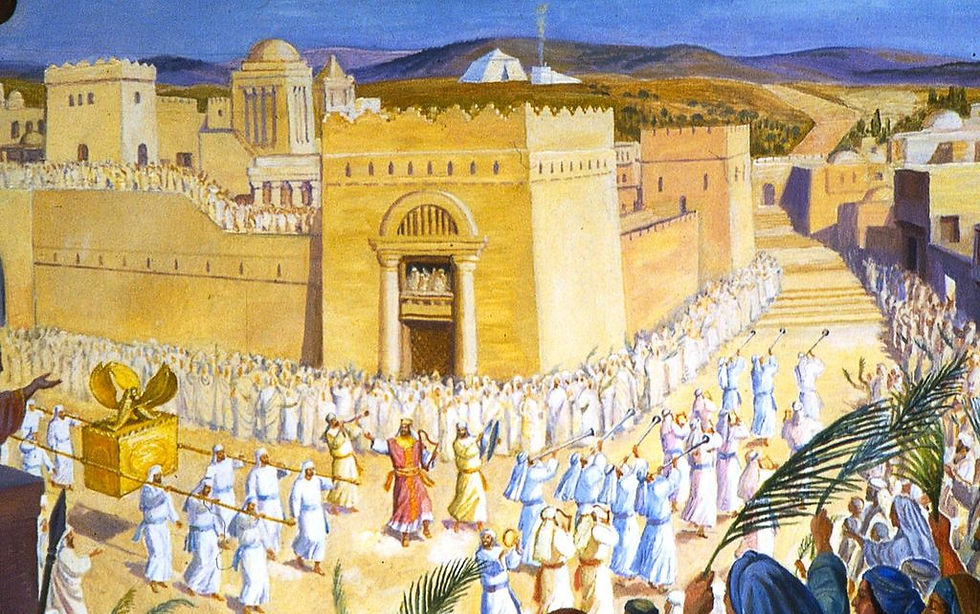
Matthew Henry: 'The temple, though richly beautified, yet while it was without the ark was like a body without a soul, or a candlestick without a candle, or (to speak more properly) a house without an inhabitant. All the cost and pains bestowed on this stately structure are lost if God do not accept them; and, unless he please to own it as the place where he will record his name, it is after all but a ruinous heap. When therefore all the work is ended (1 Kings 7:51), the one thing needful is yet behind, and that is the bringing in of the ark. This therefore is the end which must crown the work, and which here we hav…
Follow the translation of Matthew Poole's Synopsis on 1 Kings!
https://www.fromreformationtoreformation.com/1-kings
An Old Testament Survey!
www.fromreformationtoreformation.com/old-testament-survey-class-page
Lampe's History of the United Kingdom under David and Solomon!
https://www.fromreformationtoreformation.com/post/lampe-on-church-history-the-church-under-kings-before-the-division