Poole on 1 Kings 7:1-5: Solomon's House, and the House of the Forest

[A fundraising update:
While we give thanks to God for the progress and provision made, we have stalled out at about 30% of the way to our fundraising goal. We could use your help. If you are being blessed by the translation work, please consider supporting the work and speeding it on its way. Click here to watch a brief video on the project.]
[1005 till 992 BC] Verse 1:[1] But Solomon was building his own house (1 Kings 9:10; 2 Chron. 8:1) thirteen years, and he finished all his house.
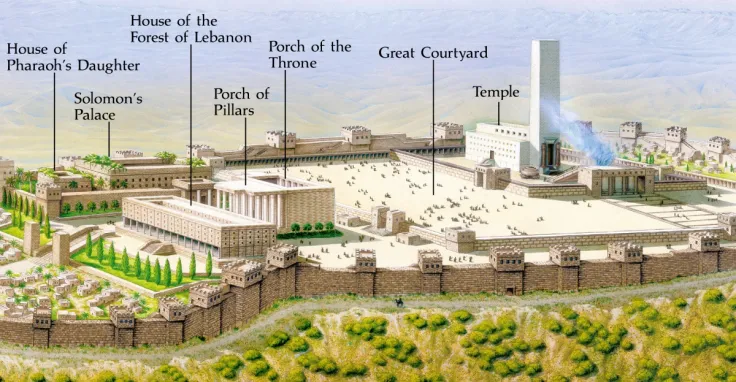
[His own house] Namely, his own palace, or palaces (Vatablus). There was one palace, the parts of which were that which was inhabited by the King and that which was inhabited by the Queen, and additionally a third part of the forest of Lebanon, which was serving for the recreation of both (Menochius nearly out of Sanchez, Pineda and Tostatus in Sanchez). Women were dwelling apart from men, Genesis 24; 31; Esther 1. It is shown in 1 Kings 3:1, that the very daughter of Pharaoh had a house with Solomon (Sanchez). Others thus: These three houses were distinct (Lapide out of Lyra and Cajetan and Vatablus); but, because they were contiguous and connected, they are called one house, 1 Kings 9:10; 2 Chronicles 8:1 (Lapide). What Solomon built was magnificent, but also commodious, and apt for use. Other Kings acted insanely, in building Colossi, and Obelisks, and Pyramids; only for the sake of their name, which nevertheless they did not obtain. For, even if part of those buildings remains, yet who may have built them is unknown. Concerning his house in the City little is here said; either because this house and the house of the forest of Lebanon were similar, in such a way that whoever knew the one knew the other; or, which I prefer, because the greater part of the former was constructed by David. Moreover, concerning these houses he speaks succinctly and obscurely. There is no mention of upper rooms, dining halls, kitchens, etc. For these buildings were secular (Martyr).
His own house; the royal palace for himself, and for his successors. Or, his houses, the singular number being put for the plural.
[Thirteen years (thus nearly all interpreters)] It is not strange that more time was spent on these, than on the Temple; because neither did he find the materials prepared (which were prepared for the Temple by David, 1 Chronicles 22:14, 15 [Estius]), nor so many works, nor did he apply such diligence and eagerness (Malvenda out of Junius). In these Solomon was not pressed by the commandment of God, or of his father. And perhaps God was more closely attending the building of the Temple with His favor (Martyr). The devotion of the people was also greater, etc. (Estius, similarly Lapide out of Josephus[2]). Others thus translate it: unto the thirteenth year of his kingdom, that is, two years after the completion of the Temple (certain interpreters in Vatablus). But they are refuted out of 1 Kings 9:10, in which twenty years are said to have been taken up in construction, etc. (Martyr).
Thirteen years; almost double the time to that in which the temple was built; because neither were the materials so far provided and prepared for this as they were for the temple; nor did either he or his people use the same alacrity and diligence in this as in the other work; nor had they the same obligations to this work as they had to that, to which they were quickened by God’s express command, and by the necessity of setting up God’s worship there, as the foundation of all the hopes and happiness both of king and people, whereas his building was only for Solomon’s greater conveniency, and he had already a palace of David’s building.
Verse 2:[3] He built also the house of the forest of Lebanon; the length thereof was an hundred cubits, and the breadth thereof fifty cubits, and the height thereof thirty cubits, upon four rows of cedar pillars, with cedar beams upon the pillars.
[He built the house of the forest of Lebanon] Thus it is called, not because it was situated there; for it was in mount Zion (Lapide, similarly Martyr), with which mountain they incorrectly imagine Libanus to be connected (Martyr). But, either, 1. on account of the abundance of cedar lumber (Vatablus), because by its cedar pillars it was imitating the cedars of Lebanon (Theodoret in Lapide); or, 2. because from there Libanus could be seen far off (Montanus in Menochius); or, 3. because it was constructed of the timbers of Lebanon (Tostatus and Serarius in Lapide). But by this rationale it had also been proper that the remaining houses of Solomon thus be named (Piscator). Or, 4. because it was in a forest that was called by the name of Lebanon; I translate it, the forest house of Lebanon. Josephus calls it the wood, or forest, of Lebanon.[4] This house was at Jerusalem (Castalio), or, not far from Jerusalem (Vatablus, Mariana). Or, 5. because it recalls Lebanon pleasantness (Lapide out of Theodoret, similarly Vatablus, Martyr, Munster, Tirinus), woods, and shade (Lapide, Martyr); there the King had fowling and hunting. It often happened that the name of a certain place was transferred to another, on account of similarity. Thus pleasant places are often called Carmel[5] (Martyr); likewise Tempe,[6] and the Gardens of the Hesperides;[7] thus all winding courses of waters are called Euripi;[8] and Cicero’s villa was called the Academy[9] (Tirinus out of Sanchez). But to this opinion it is set in opposition, that the house is not called the forest of Lebanon, but the house of the forest of Lebanon. It is likely that this was a summer house, inasmuch as shade and breeze might be sought there (Piscator). The Chaldean translates it, a house of cooling (Vatablus). It was built on mount Libanus itself, after Hamath, the royal city of Lebanon, was captured by Solomon, 2 Chronicles 8:3 (Malvenda out of Junius).

The house of the forest of Lebanon; a house so called, either, first, Because it was built in the mountain and forest of Lebanon, for his recreation there in summer time. But it is generally and more probably held, that it was in or near Jerusalem, both because there was the throne of judgment, verse 7, which was fittest to be in the place of his constant and usual residence; and because there was the chief magazine of arms, Isaiah 22:8, and Solomon’s golden shields were put there, as is manifest from 1 Kings 10:17; 14:25, 26, 28, which no wise prince would do in a place so remote from his royal city, and in the utmost borders of his kingdom, as this was. Or rather, secondly, From some resemblance it might have with that place, for the pleasant shades and groves which were about it; nothing being more frequent, both in sacred and other writers, than to transfer the names of Carmel, or Tempe, or the like, to other places of the same nature and quality with them.
[Of one hundred cubits of length, etc.] Nevertheless, the royal house was not more spacious than the Temple, if with the Temple we include the vestibule and courtyard (Martyr); also, they were not the sacred and greater cubits, but the common and lesser (Malvenda out of Junius).
The length thereof, to wit, of the principal mansion; to which doubtless other buildings were adjoined.
[Of thirty cubits of height] Either, 1. to the first floor, between which and the ceiling another thirty cubits intervened; or, 2. to the ceiling; of these fifteen cubits were given to the lower part, and fifteen to the upper part. Thus the height of this house and that of the sacred house were equal (Martyr).
[And four promenades between the cedar pillars] Below and under the house. Of which two were between the columns themselves; two between the columns and the walls of the house (Lapide). עַ֗ל אַרְבָּעָה֙ טוּרֵי֙ עַמּוּדֵ֣י אֲרָזִ֔ים, upon four rows of cedar columns (Pagnine, Montanus, Vatablus, Junius and Tremellius, etc.). In the individual rows there were fifteen columns (Vatablus, Martyr); which is able to be proven from the first floor of the first mansion; therefore, there were just so many in each row (Vatablus). This is the lowest story of the house (Piscator out of Junius). The external columns were enclosed in the wall, for the whole house was not open, neither were the spaces between columns within empty, but separate and distributed into diverse quarters and offices. But the upper house had three rows of columns, because its columns carried less weight (Martyr). And so that the place might be more spacious, because a great many were resorting to the King (Vatablus). [Others thus:] That עַל/upon I take for next to, or for besides; that is to say, besides the columns, that which was here given was the measure of the house. But, for what use were these columns? Perhaps an open central courtyard was surrounded on every side with colonnades. Were there multiple stories? absolutely, as it will now be explained (Mariana).
Upon four rows of cedar pillars; upon which the house was built, and between which there were four stately walks.
[For he had cut cedar beams into pillars, וּכְרֻת֥וֹת אֲרָזִ֖ים עַל־הָעַמּוּדִֽים׃] And beams cut (or their capitals [Jonathan], crossbeams [Syriac], planks [Arabic], beams [Munster, Pagnine, Vatablus], beams hewn [Tigurinus]) upon the pillars (Montanus), understanding, were (Pagnine), that is, lying, not upright (Osiander, Mariana). The beams were positioned according to the width, not according to the length (Vatablus). Upon the pillars were placed crossbeams, that is, transverse beams; upon these were placed the floors; that is, the edifice itself (Castalio). [Others thus connect this with what precedes, and translate it:] Upon the four rows, etc., and cedar beams placed on pillars; that is, the floor of the middle story, upon which were placed forty-five pillars, concerning which verse 3 speaks; they were constituting the middle floor. Therefore, here is a metonymy of material (Piscator out of Junius).
With cedar beams upon the pillars; which were laid for the floor of the second story.
Verse 3:[10] And it was covered with cedar above upon the beams (Heb. ribs[11]), that lay on forty five pillars, fifteen in a row.
[And with boards of cedar he covered, etc., וגו״ וְסָפֻ֣ן בָּאֶ֗רֶז מִמַּ֙עַל֙ עַל־הַצְּלָעֹת֙] And it was covered with cedar boards above upon the beams (ribs, or flanks [Montanus, Junius], plank [Jonathan]), which were upon forty-five pillars (Pagnine, similarly Montanus, Syriac). Then was laid a floor of cedar upon those beams, which, as joists, were resting upon those forty-five pillars (Munster). And the ceiling of cedar above (this is the third and highest story), above the planks (by which, of course, the middle story was enclosed), which was above the forty-five pillars (Junius). Upon the pillars were placed beams; upon the beams, joists, which in French we call Solives; but upon the joists were cedar boards (Vatablus). Moreover, the spaces between the columns were not empty, but full, and joined by cedar planks, so that the story might be complete (Malvenda).
[One row was having fifteen pillars, חֲמִשָּׁ֥ה עָשָׂ֖ר הַטּֽוּר׃] Fifteen in a row (Montanus, Jonathan, Junius and Tremellius), or by each row (Pagnine, similarly the Syriac, Arabic, Tigurinus, Strigelius). Hence it appears that there were three rows: evidently there were four rows of pillars, that is, on the four sides of the building; and in turn three, if you have regard to the height: the building had three stories, and the same number of galleries, through which one was entering into the chambers; there were five pillars on each of the three sides of the open central court: on the fourth side four: thus all the pillars of one row were fifteen, and of one story were fifteen (Mariana).
Forty five pillars, fifteen in a row: So in this second story were only three rows of pillars, which was sufficient for the ornament of the second, and for the support of the third story.
Verse 4:[12] And there were windows in three rows, and light was against light (Heb. sight against sight[13]) in three ranks.

[Set one over against another,וּשְׁקֻפִ֖ים שְׁלֹשָׁ֣ה טוּרִ֑ים וּמֶחֱזָ֥ה אֶל־מֶחֱזָ֖ה שָׁלֹ֥שׁ פְּעָמִֽים׃ [14]] And of windows (of views [Junius and Tremellius], that is, windows for viewing [Junius], of lights [Tigurinus], of lookouts [Munster], of balconies [Syriac, Arabic]) were three rows (Pagnine, similarly Montanus, Munster, Tigurinus); and window was toward, or over against, window (or was joined to window [Tigurinus], or of which view was directed toward view; that is, parallelograms were opposite to each other, and on each floor the upper were suitably corresponding to the lower vertically [Junius]) in a triple series or row (Junius and Tremellius, Piscator), that is, equally on both sides of the length, and also on the height, the windows had corresponding alignment (Junius). Others: and that in three walls (Tigurinus, Mariana out of the Hebrews). Whereby he indicates that the windows were in three walls only, but the fourth wall did not have windows (since the adjoined portico was preventing [Martyr]), nor chambers (Mariana). There were three stories, and in each story there was one row of windows (Menochius). It had so many windows, because it was a summer house (Martyr). Between these rows there was a solid wall for the strength of the mass (Osiander).
Light was against light; one directly opposite or answering to the other, as is usual in well-contrived buildings. In three ranks; one exactly under another.
Verse 5:[15] And all the doors and posts were square, with the windows (or, spaces and pillars were square in prospect[16]): and light was against light in three ranks.
[And looking one upon another, etc, וְכָל־הַפְּתָחִ֥ים וְהַמְּזוּז֖וֹת רְבֻעִ֣ים שָׁ֑קֶף [17]] And all the doorways (doors [Syriac], entrances [Junius and Tremellius, Mariana]) and posts were squared (Pagnine, Montanus), a window (Montanus, Mariana), in the place of, with a window. In each door there was a little window, to see who might be knocking; which is done in Monasteries (Martyr). Others: together with the windows (Pagnine, Vatablus). In Hebrew, a singular in the place of the plural; that is, with the boards of the windows, which were surrounding the window; that is to say, All the lintels of the doors and the posts, with the frames of the windows, were squared (Vatablus). Others: squared, of uniform appearance (the Dutch out of Junius). Doors, etc., squared with their lintel (Junius and Tremellius). All the openings of the windows and the posts (or and the doors [Castalio]) were squared (Tigurinus) [the שָׁקֶף they move from the end to the middle of the verse]. The doors with the posts and lintel were in a quadrangular form (Munster, similarly Strigelius). [Thus they express רְבֻעִ֣ים שָׁ֑קֶף, which verbatim are able to be translated, squared in appearance.]
[Quadrangular boards equal in all, וגו״ וּמ֧וּל מֶחֱזָ֛ה] Now, window was directly over against window in three turns (Pagnine, etc.) [as in the preceding verse]. For the Hebrews are wont sometimes to repeat things said previously. Now, the windows were set over against each other, so that the air might be able to pass through, and the hall might be more salubrious (Osiander). The sense: All the boards of the windows were corresponding to each other, in three rows (Vatablus). He was signifying these little windows that were in the doors, and so that the doors were facing each other, and were corresponding with each other (Martyr). And the alignment [the מוּל, in front of, they appear to have taken as a noun] of view to view in a triple series (Junius and Tremellius), that is, in such a way that the windows and doors of the two sides were aligned each directly opposite to each, in each of the stories (Junius, Piscator).
Light was against light: He speaks either, first, of the same lights mentioned verse 4, it being the manner of the Hebrews to repeat the same things; or rather, of the smaller windows or lights, which were over the several doors, as the manner of many buildings is.
[1] Hebrew: וְאֶת־בֵּיתוֹ֙ בָּנָ֣ה שְׁלֹמֹ֔ה שְׁלֹ֥שׁ עֶשְׂרֵ֖ה שָׁנָ֑ה וַיְכַ֖ל אֶת־כָּל־בֵּיתֽוֹ׃
[2] See Antiquities 8:5:1.
[3] Hebrew: ויִּ֜בֶן אֶת־בֵּ֣ית׀ יַ֣עַר הַלְּבָנ֗וֹן מֵאָ֙ה אַמָּ֤ה אָרְכּוֹ֙ וַחֲמִשִּׁ֤ים אַמָּה֙ רָחְבּ֔וֹ וּשְׁלֹשִׁ֥ים אַמָּ֖ה קוֹמָת֑וֹ עַ֗ל אַרְבָּעָה֙ טוּרֵי֙ עַמּוּדֵ֣י אֲרָזִ֔ים וּכְרֻת֥וֹת אֲרָזִ֖ים עַל־הָעַמּוּדִֽים׃
[4] Antiquities 8:5:2.
[5] כַּרְמֶל/Carmel, from כָּרַם, to dress vines, was a mountain range in northern Israel, along the Mediterranean coast, known for its pleasant and fruitful slopes. Its name was transferred to other similar places. For example, Isaiah 32:15, 16: “Until the spirit be poured upon us from on high, and the wilderness be a fruitful field (לַכַּרְמֶל, for Carmel), and the fruitful field (וְכַרְמֶל, and Carmel) be counted for a forest. Then judgment shall dwell in the wilderness, and righteousness remain in the fruitful field (בַּכַּרְמֶל, in Carmel).” This practice continued through the Medieval and Renaissance periods.
[6] Tempe is a famously beautiful valley in northern Greece, between Mount Olympus and Mount Ossa in Thessaly. It was considered sacred to Apollo; he is said to have purified himself there after the slaying of Python. In classical literature, Tempe became a symbol of natural beauty. See Virgil’s Georgics 2:469-471, and Æneid 7:799; Horace’s Odes 1:7:4; 1:21:9, 10; Pliny’s Natural History 4:8; Strabo’s Geography 9:5:2.
[7] In Greek mythology, the Gardens of the Hesperides were a paradise located on the western edge of the world, often used as a symbol of beauty, abundance, and eternal spring. The Gardens were filled with golden apples, and guarded by the Hesperides (the nymph daughters of Atlas) and the dragon Ladon.
[8] Euripus is the ancient name for the narrow strait between the island of Eubœa and the mainland of Greece. It became famous for its strong, rapidly reversing tidal currents. It came to be used as a symbol for anything turbulent or winding. See Strabo’s Geography 9:2:2; 9:5:2; Pliny’s Natural History 4:8; Livy’s History of Rome 28:6.
[9] Cicero called his Tusculan villa his “Academy”, after Plato’s famous school. Cicero’s “Academy” was his main retreat for study, writing, reflection, and philosophical conversation.
[10] Hebrew: וְסָפֻ֣ן בָּאֶ֗רֶז מִמַּ֙עַל֙ עַל־הַצְּלָעֹת֙ אֲשֶׁ֣ר עַל־הָֽעַמּוּדִ֔ים אַרְבָּעִ֖ים וַחֲמִשָּׁ֑ה חֲמִשָּׁ֥ה עָשָׂ֖ר הַטּֽוּר׃
[11] Hebrew: הַצְּלָעֹת.
[12] Hebrew: וּשְׁקֻפִ֖ים שְׁלֹשָׁ֣ה טוּרִ֑ים וּמֶחֱזָ֥ה אֶל־מֶחֱזָ֖ה שָׁלֹ֥שׁ פְּעָמִֽים׃
[13] Hebrew: וּמֶחֱזָ֥ה אֶל־מֶחֱזָ֖ה.
[14] שָׁקַף can signify to overhang, or to look out.
[15] Hebrew: וְכָל־הַפְּתָחִ֥ים וְהַמְּזוּז֖וֹת רְבֻעִ֣ים שָׁ֑קֶף וּמ֧וּל מֶחֱזָ֛ה אֶל־מֶחֱזָ֖ה שָׁלֹ֥שׁ פְּעָמִֽים׃
[16] Hebrew: וְכָל־הַפְּתָחִ֥ים וְהַמְּזוּז֖וֹת רְבֻעִ֣ים שָׁ֑קֶף.
[17] פָּתַח signifies to open; שֶׁקֶף, framework, casing, or window, from שָׁקַף, to overhang, or to look out.


Matthew Henry: 'Never had any man so much of the spirit of building as Solomon had, nor to better purpose; he began with the temple, built for God first, and then all his other buildings were comfortable. The surest foundations of lasting prosperity are those which are laid in an early piety, Matt 6:33. 1. He built a house for himself (1 Kings 7:1), where he dwelt, 1 Kings 7:8. His father had built a good house; but it was no reflection upon his father for him to build a better, in proportion to the estate wherewith God had blessed him. Much of the comfort of this life is connected with an agreeable house. He was thirteen years building thi…
Follow the translation of Matthew Poole's Synopsis on 1 Kings!
https://www.fromreformationtoreformation.com/1-kings
An Old Testament Survey!
www.fromreformationtoreformation.com/old-testament-survey-class-page
Lampe's History of the United Kingdom under David and Solomon!
https://www.fromreformationtoreformation.com/post/lampe-on-church-history-the-church-under-kings-before-the-division
Get Heidegger's Handbook of the Old Testament!
https://www.lulu.com/shop/steven-dilday/handbook-of-the-old-testament/hardcover/product-q65wzzm.html?q=johann+heinrich+heidegger&page=1&pageSize=4